Friday, January 6, 2023
Down Under!
Sunday, March 6, 2022
Bonus 78s - Sailing Along!
If you've been paying attention, you'll know it's time to hear some recordings of the songs from 1938's "Sailing Along" starring Jessie Matthews!
Jessie cut the four main songs from the movie for British Decca backed by Peter Yorke and his Orchestra.
Here's the coupling of "Souvenir of Love" and "Trusting My Love":
And here's "Your Heart Skips a Beat" backed with "My River":
Sounds good!
Decca also had Sidney Lipton and his Grosvenor House Orchestra record "Souvenir of Love" and "Trusting My Luck" with the great Al Bowlly on vocals:
Al Bowlly was just a great singer. He's best-known for his many recordings with Ray Noble both in England and the U.S.
RCA had British bandleader Roy Fox record the same two songs (flipping them as the A and B sides) which they released in America on the Bluebird label:
To top it all off, RCA also had the musical director of "Sailing Along," Lou Levy, record all four songs on two sides on their British His Master's Voice label featuring vocalists Gerry Fitz Gerald and Eve Becke:
Lou Levy worked on a ton of British films including the Alfred Hitchcock classics "The 39 Steps" and "The Lady Vanishes."
Lots of good recordings of the "Sailing Along" songs!
Friday, March 4, 2022
Bonus 78s - Gangway!
Since I was just talking about the 1937 movie "Gangway" starring Jessie Matthews and Barry MacKay and since I never pass up the opportunity to listen to some 78rpm records, let's hear some of the songs from the movie!
Saturday, May 8, 2021
Of Pocket Books and Whatnot...
While thinking about the edition of "A Christmas Carol" published in 1939, I was reminded that one of those stray trivia things it seems like I've always known is that the first Pocket Book to be released was "Lost Horizon" by James Hilton. Haven't had much practical use for that fact until now, I guess!
Tuesday, February 9, 2021
Bonus: Charles Laughton - "Mr. Pickwick's Christmas" (Decca Records 1944)
Charles Laughton
Decca Records
Watching "The Pickwick Papers" (1952) naturally put me in a Pickwick mood, so I immediately thought of this 1944 78rpm record album from Decca Records featuring Charles Laughton reading "Mr. Pickwick's Christmas."
This particular recording seems inextricably linked with Ronald Colman's Decca recording of "A Christmas Carol" ever since they were reissued as two sides of an LP in 1950.
It's a lot of fun, so give it a listen:
And don't forget that Charles Laughton recorded his own version of "A Christmas Carol" for RCA Victor in 1951, as discussed here, here, here and here!
Sunday, December 13, 2020
"A Christmas Carol" All-Star Team - Day 13
Our selections for the "A Christmas Carol" All-Star team continues with the Christmas Yet to Come sequence.
An important element of that scene are the random businessmen discussing the recent death of Scrooge (although Scrooge is oblivious that he's the subject of the talk).
There are two conversations in the book. First are four businessmen who talk about it likely being a cheap funeral and all.
Then there's the two big-shot guys who have the "Old Scratch" exchange.
Just about every adaptation has some version of these conversations, often combined into one.
In order to represent one of my favorite adaptations, we go with the "Men in Street" from Ronald Colman's famous Decca recording of 1941!
The men are played here by accomplished radio actors Fred MacKaye and Gale Gordon, who also double as Fred and the "3rd Ghost," respectively.
Fred MacKaye did a lot of radio work as an actor and also wound up as director of "The Lux Radio Theatre," a hugely popular show back in the day.
There was another actor named Fred MacKaye who made some movies but passed away in 1944, whereas "our" Fred was around until 1988. But, boy, does it get confusing while researching!
He was well-known for his portrayals of Mayor LaTrivia on the "Fibber McGee and Molly" radio show and Mr. Conklin on the "Our Miss Brooks" radio and TV shows. His biggest claim to fame was for (barely) enduring the antics of Lucille Ball on "The Lucy Show" and "Here's Lucy" TV series in the 1960s and 1970s.
Thursday, November 19, 2020
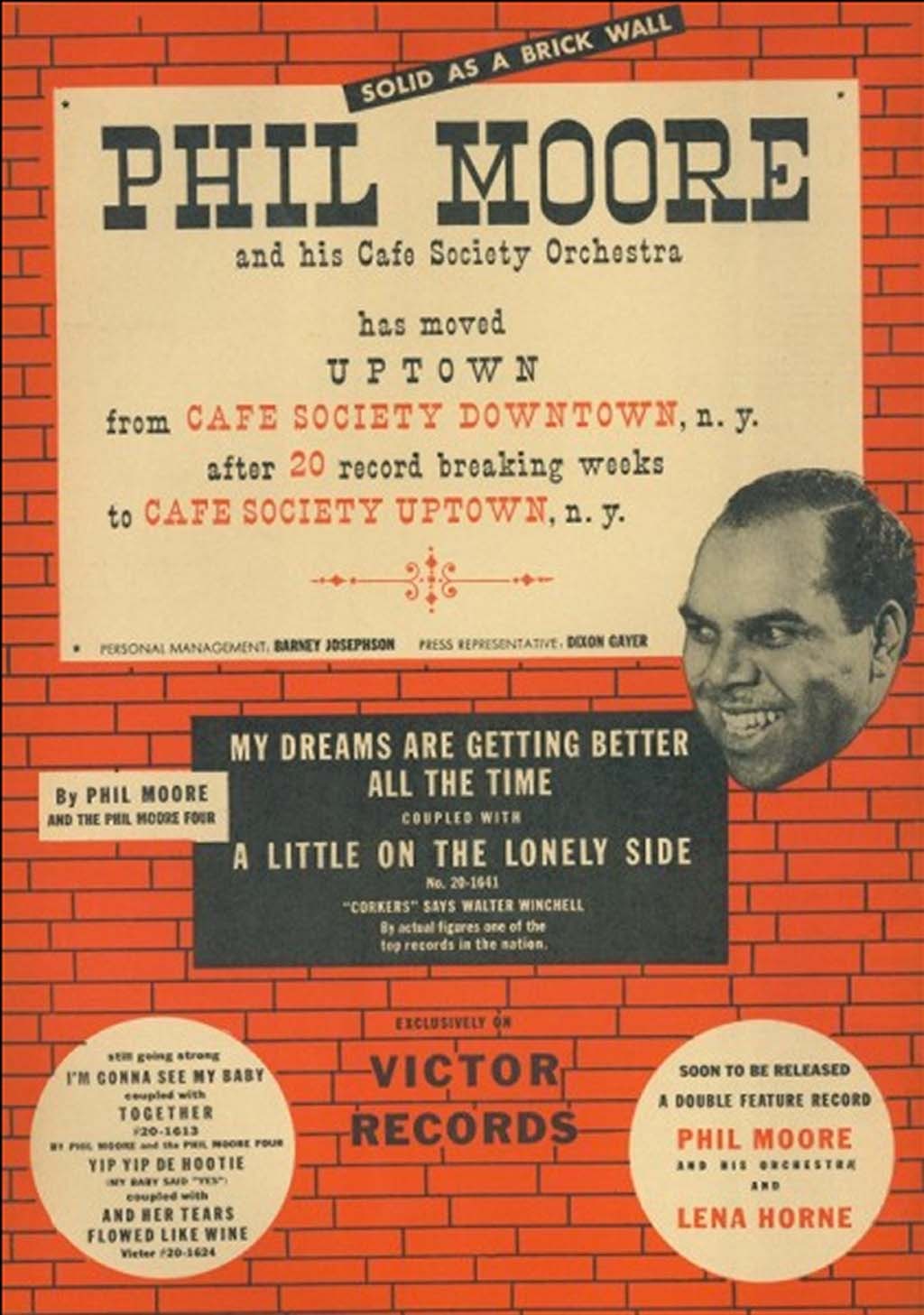
Bonus Phil Moore!
The question from last time was whether we were done with Phil Moore. The answer of course is a resounding NO!
When I think of Phil Moore, I actually think of a couple of snappy WWII era songs that he wrote.
If you were to do word association thing with me and said, "Phil Moore," my answer would be "Shoo-Shoo Baby!"
That was a song sung by the Andrews Sisters in the movie "Three Cheers for the Boys" and their single of the song on Decca Records was a huge hit in 1944:
From my penchant for reading record labels and such, I knew that someone named Phil Moore had written this sing before I knew there was a group called the Phil Moore Four. I don't know how I ever found out anything in those dark, pre-Internet days!
I also like the song "I'm Gonna See My Baby" (also 1944) which I was familiar with by way of Johnny Mercer's version on Capitol Records, the flipside of his huge hit "Candy" (sung with the great Jo Stafford and the Pied Pipers):
Thanks to the Internet, I was finally able to hear Phil Moore's version of "I'm Gonna See My Baby" with the Phil Moore Four from his earlier stint on RCA Victor Records:
Phil's version is definitely jazzier than Johnny's big band record. I get a strong King Cole Trio vibe, which is a beautiful thing!
Here's "Billboard's" take:
Interesting to know it was his wax bow!
OK, we'll leave Phil Moore alone for a while!
Wednesday, November 18, 2020
"Chinchy Old Scrooge" - Phil Moore with the Phil Moore Four (1953) - Part 4
One particular line goes, "This ain't a fit night out for Clyde McCoy!"
Being somewhat hip by 1953 standards myself, I immediately recognize Clyde McCoy as the embodiment of corny music. He was a popular bandleader and trumpet player who featured the ultimate "wah-wah" sound on his horn. (This circuitously led to the non-corny wah-wah pedal for guitars in the 1960s, but that's another story!)
His type of square music is typical of what the bop cats were rebelling against. The difference between Clyde McCoy as a trumpeter and, say, Dizzy Gillespie is incalculable!
The thing is that I think Clyde McCoy is awesome! I absolutely love his theme song "Sugar Blues." He recorded it a few times, but my favorite is his 1935 version for Decca Records:
I love hipsters vs. squares circa 1953!
Tuesday, June 30, 2020
"A Christmas Carol" (1941) - Victor Records - Part 4
A few (?) words about Ernest Chappell's 1941 adaptation of "A Christmas Carol" on Victor Records and how it compares to a couple of other, more famous, 78 rpm albums from the same timeframe.
The big competition for this set was the album from Decca Records starring Ronald Colman as Scrooge, as both were released for the 1941 holiday season.
Ronald Colman was a big star at the time and everybody loved his voice, so the Decca set would naturally attract more attention, as Ernest Chappell wasn't a household name anyway.
Then 1942 saw Columbia Records issue their version with Basil Rathbone as Scrooge. Rathbone was never as big a star as Colman, but he was still a name to be reckoned with and very familiar to 1940s record buyers. He's probably better remembered today than Ronald Colman, if only because of the Sherlock Holmes connection.
But if you take away the star power, is Ernest Chappell's version better?
Well, one thing it has going for it is a longer running time. The album has four records rather than the three of the other two, so there's more time to work with. Chappell's runs about 40 minutes, whereas Rathbone and Colman get only about 25. So, there's that.
Since Ernest Chappell is an announcer acting as narrator, his version has quite a bit more text from the book, including the "standing in the spirit at your elbow" line, which is so seldom heard.
The Decca version has Ronald Colman narrating as Scrooge, so the vibe is quite different. The Columbia version has a "star" announcer in Harlow Wilcox, but he only provides an introduction. The rest of the recording has the characters providing a lot of expository dialogue.
So, the Chappell version is like someone reading the book to you with the characters acting out scenes, whereas the Colman one is Scrooge telling us his story and the Rathbone version is like it's playing out as we listen.
The approaches are different, which I think is good, as I wouldn't want the same thing over and over with only the cast changing. I also think it's fun that each of the big three record companies of the time had competing versions.
It's interesting that the (RCA) Victor version seems to have the lowest budget, as they were extremely successful at the time with Glenn Miller and Tommy Dorsey among a number of top bands signed to the label.
In the final analysis, if I were back in the early 1940s and could only buy one, I'd still go with Ronald Colman. It's the voice!
Tuesday, April 28, 2020
Decca Records - "Mr. Scrooge" (1964) - The Orchids
"Mr. Scrooge" (1964)
Decca Records
The Orchids
From the early days of records, let's jump ahead about 50 years to the mid-1960s for the first of a few pop songs making use of old Ebenezer Scrooge...
This first one is from the Orchids, a trio of British schoolgirls, in 1964. They had a few singles on Decca Records in England, but they did not become big stars. They had the "Girl Group" sound that had been popular, but in 1964, other British groups were introducing new sounds that changed the world.
This brings us to their recording of "Mr. Scrooge" from 1964. They performed it in the British film "Just for You" (1964), which was apparently released in America as "Disk-O-Tek Holiday." The main attraction seems to be the little music segments (like primeval music videos) of various recording acts.
I don't think there was a single release of "Mr. Scrooge," but it was included on the soundtrack album.
In any event, it's a fun little novelty with that "Girl Group" sound.
Here it is:
Next up: another Scrooge-related cut...
Friday, April 24, 2020
Bonus Bransby!
A little bonus Bransby Williams...
This recording is an earlier version of the third part of Mr. Williams's Scrooge monologue, the "Awakening of Scrooge" part. A little shorter, but pretty similar.
It's definitely from an Edison cylinder, which I think is from 1905. It has the spoken introduction common to cylinders of that time. So, pretty early in the scheme of things!
Give it a listen:
I'm not sure how many recordings he made of this material and it's not easy to find out which is which.
Here's a British LP from 1952 on Decca Records. Are they new recordings or reissues? The liner notes refer to Mr. Williams as an octogenarian, which would seem to indicate these are freshly recorded. Maybe someday I'll get my mitts on a copy, then I'll know!
The more I listen to Bransby Williams, the more I think he sounds a bit like Lionel Barrymore. Did Lionel possibly find inspiration for his take on Scrooge from those old records? I guess we'll never know, but intriguing nonetheless!
Saturday, February 8, 2020
Rathbone vs. Colman!
The 1942 recording of "A Christmas Carol" from Columbia Records starring Basil Rathbone invites comparisons to Ronald Colman's version on Decca Records from the year before.
I really like these type of records. It's fun that there are several different ones, as it's interesting to see how the adapters manage to squeeze whatever material they can into the running time available. Both of these are albums of six 12-inch 78 rpm records, so they're about the same length.
I think both are great. Each has a stellar lead and top supporting cast.
As mentioned last time, Ronald Colman's Scrooge narrates the story as if it had already happened sometime in the past, whereas Basil Rathbone is describing things as they happen.
Another difference is that Colman uses his "real" voice, which is awesome, whereas Rathbone affects something of an "old man" voice.
This seems fitting as Ronald Colman was a MOVIE STAR and Basil Rathbone was more of a star character actor.
![]() |
| No doubt who was the star in 1935! |
![]() |
| Basil worked his way up a bit by 1938! |
Colman never played Scrooge in movies or TV, but Rathbone played Scrooge twice on TV, in 1956 and 1959. He easily could've headlined a movie version, if something like that would've happened.
You can have a fun little mini-marathon watching and listening to Basil Rathbone's various Scrooge projects, throwing in his turn as Marley's Ghost in the 1954 "Shower of Stars" adaptation with Fredric March.
I'm not sure how Ronald Colman would have been as Scrooge in a movie. On the whole, he was too handsome and charming for such a role. I understand that he was protective of his brand and perhaps he wouldn't have wanted to have been buried under makeup not befitting a matinee idol and/or appear in a role that his fans might not like.
But Colman's great voice and acting skills easily translate to the audio world and he does a great job as Scrooge on his recording.
![]() |
| An awesome color photo of Hollywood's British colony. How many of these stars do you recognize? |
So, two great actors with different approaches.
I say it's a tie!
Tuesday, October 29, 2019
A Christmas Carol (1941) - Ronald Colman (Part 2)
So, did you listen to it? What a voice, right?
I like this a lot. It has solid production values, moves along well and doesn't dumb it down.
OK, so, now here's where my OSD kicks in and we see what this version includes, omits and adds!
With the half-hourish running time, they could actually cram a lot of the book in there, but some things needed to be omitted for time constraints and some things changed a bit to fit the audio-only format.
I thought it was really interesting that Scrooge was the narrator. I don't know how many adaptations have used that idea, but certainly not many. I think it's a good touch and allows us to hear that much more of Ronald Colman's velvet tones!
Scrooge sets the story in 1843, the year of publication the original book. Good to know.
Scrooge never does call his nephew by name here and we don't go to his party, so there's no one else to call him Fred. The cast lists Fred (Nephew) as a character, because you might not know who Fred is otherwise.
I think this is the only version in which Scrooge says that his nephew has a child. I wonder why they threw that in.
There's only one gentleman to ask Scrooge for a donation to charity. As in the book, he's not named, but the cast lists him as "Mr. Portly!" I think it's funny that Scrooge makes a joke about Marley's liberality! He's pretty sarcastic on the whole here.
This version uses the relatively common variation of all the ghosts appearing in one night. Marley says the first will come at 1:00, the second at 2:00 and the third at 3:00.
Naturally we can't have everything the various ghosts would have shown Scrooge in each sequence, but we get a couple with each.
In the past, we get lonely Scrooge at school and his breakup with Belle, who's also not called by name here, but listed as Belle (Sweetheart). No Fezziwig here, so we don't actually see Scrooge happy in the past - which he points out to the next ghost!
In the present, we have Scrooge describing the various people he sees celebrating Christmas. This is taken right out of the book, but a lot of versions don't include this.
We go to Bob Cratchit's house to see his Christmas dinner. Scrooge had no idea that Bob had a family. Interestingly, the ghost says he has five children. He usually has six. Hmmm... Besides Tiny Tim, we hear Mrs. Cratchit mention Martha and Peter.
Speaking of Tiny Tim, he does have a wacky voice, obviously palyed by an adult woman (Barbara Jean Wong). Tiny Tim is so hard to cast! Tiny Tim sings a song, as he does in the book, but it's just heard in the background as Scrooge and the ghost talk.
As mentioned, we don't get to go to Fred's party.
One big change here is that the Ghost of Christmas Present talks! They must have done this to avoid having Scrooge just talking to himself. It's different, but fits the format fine.
We get Scrooge's business associates discussing his death in he usual casual manner, but we don't get his things being sold off.
What we do get that is extremely rare is Scrooge pulling down the shroud on his corpse to see his own face! Almost always Scrooge refuses to do it. Maybe too hard (and creepy) to do in live-action, but it makes for a good bit here.
Instead of Bob Cratchit talking about Tiny Tim's death with his family, he talks to Tim in the graveyard. Interestingly, we learn that Tiny Tim was born in 1838 and was seven years old when he died. So, the future here is 1845, two years later. Way more specific than usual!
Scrooge wakes up on Christmas morning and talks to the kid who buys the turkey. He then relates the rest of the story to us, how he had dinner with his nephew and raised Bob's salary. He says that was a memorable day, so he must have gone to Bob's house later that same day.
Am I reading too much into all of this? One hundred percent! But, hey, that's what I do!
Monday, October 28, 2019
A Christmas Carol (1941) - Ronald Colman (Part 1)
A Christmas Carol (1941)
Director: George Wells
Scrooge: Ronald Colman
So, remember when I was saying that the 1938 MGM adaptation could use a bigger star, such as Ronald Colman, as Scrooge? Well, we're going to jump ahead a few years to 1941 and take a look at a record album from Decca, featuring... Ronald Colman!
This was a set of three 12-inch 78 rpm records, which allowed for about a half-hour of material.
Full disclosure: I love listening to old radio shows, and this recording is done in that style, as noted, with a supporting cast, sound effects and music. So, I think it's awesome, but as they say, your mileage may vary.
Back in 1941, radio was king. You could listen to your favorite shows, but you had to be right there when they were on. Then after the broadcast, the shows were gone forever.
So, imagine the thrill of having a handsomely produced drama on records that you could play whenever you wanted. Sort of like primeval home video!
Make that drama one of your favorite stories starring a top movie star and you've really got something!
It doesn't take much to make me think of a family listening to this album as a tradition on Christmas Eve, gathered around the big radio/phonograph combination, fireplace roaring, maybe sipping some hot cocoa. What could be better?
So, what makes this so special? Well, for starters, you have Ronald Colman narrating the proceedings as Scrooge. He was a great icon of the Golden Age of Hollywood, starring in such classics as "A Tale of Two Cities," "Lost Horizon," "The Prisoner of Zenda," "Random Harvest" and others (check out any and all of those!). And for my money, he had the best voice of any actor ever. One of those that you would pay to hear read the phone book, as they used to say when we still had phone books!
The guy had sophisticated charm and class to spare!
This project gives Mr. Colman topnotch support. Musical director Victor Young and vocal director Ken Darby were tops in their fields. (Side note: Ken Darby arranged a wonderful version of "The Night Before Christmas," which he performed annually with his group the King's Men on the "Fibber McGee and Molly" show.)
The supporting cast is full of top radio actors, with Hans Conreid (voice of Captain Hook and Snidely Whiplash among many others) and Gale Gordon (of "Our Miss Brooks" and "The Lucy Show") most familiar to more modern listeners.
I feel I would be remiss if I did not point out that the actor who plays Bob Cratchit, Eric Snowden, appeared on two episodes of "Leave It to Beaver!" He's an ultra-sophisticated salesman in each. He sells Aunt Martha that Little Lord Fauntleroy suit that Beaver has to wear to school, as well as the hunting jacket the boys buy as a present for Ward. Fun!
As I understand it, this record set was popular when it came out and I don't think it's ever really been out of print. It started out as 78s, later showed up as a set of 45s, then LP, cassette, CD and is even now available as a digital download. Probably even had an 8-Track!
Enough talk for now. If you've never heard it before, give it a listen and we'll talk about it a bit...