Showing posts with label Seymour Hicks. Show all posts

Sunday, May 29, 2022

A Little Advertising!

 I don't think I've seen this ad before:

Interesting that "The Little Cratchits" get some love!

Sunday, January 30, 2022

Yes, Sir!

Not sure of the source of this one either, but it's striking:


Inspired by Sir Seymour Hicks, maybe?

Saturday, April 3, 2021

"The Cinema" - No. 38, Vol. III (July 2, 1913)


We jump ahead a few years with Seymour Hicks and leave the stage world to enter the movie world with this 1913 issue of "The Cinema," another British magazine.

This issue has a few items related to the 1913 silent film "Scrooge":


These show that the title of this 1913 release was originally "Scrooge," not "Old Scrooge" as is sometimes indicated these days.

"Old Scrooge" was the 1923 reissue of the 1913 "Scrooge." I think the original 1913 cut is lost, but we're fortunate to have the reissue still around.

This rundown of the 1913 film shows it's pretty similar to the reissue cut:


The movie seemed to play well in 1913, but I think it would have seem dated by 1923.

I'm sure we'll encounter Sir Seymour again in the future, but this is the end of our little walk down memory lane for now!

Friday, April 2, 2021

Cassell's Magazine (December 1903 - May 1904)


We stay way back in the early 1900s with (not-yet-Sir) Seymour Hicks for this story from Cassell's Magazine, which profiles him and his wife Ellaline Terris:

A good portrait of Hicks as Scrooge and it's interesting to read about him in his earlier days.


Thursday, April 1, 2021

"The Sketch" - Volume XXXVI (October 23, 1901 - January 15, 1902)


Here's a fun little find from a 1901/1902 issue of the British periodical "The Sketch":


A rare chance to see what a stage version of "Scrooge" starring Seymour Hicks!

We see both Bob Cratchit and Fred offering a toast to Scrooge.

A couple of takeaways from the Fred picture: Fred's last name is Wayland and it looks like he has four kids!

And I find it it interesting that the Cratchit family has a sign reading, "God Bless Us, Everyone." It's reminiscent of the scene from the 1901 silent movie:


I had though the movie had that sign because we couldn't hear Tiny Tim say his line, but apparently it was all the rage to have such a sign in 1901!

Do I need to hang one up for my next Christmas dinner?

In any event, this seems to indicate that Seymour Hicks was calling his adaptations "Scrooge" from way back when, not using the title "A Christmas Carol."

This issue of "The Sketch" also includes this little profile of the woman who composed the music for the "Scrooge" show:


Not sure if it's gossip, but interesting!


Monday, September 7, 2020

"Scrooge" (1935) Lobby Cards and Stills


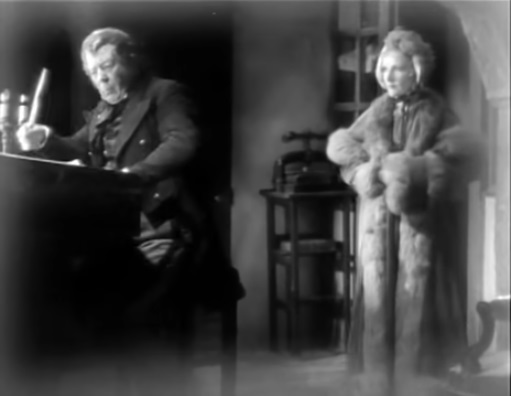
We're still in lobby card mode as we turn our attention to another notable British film version of "A Christmas Carol" titled "Scrooge," this one the 1935 effort starring Sir Seymour Hicks.

Actually, lobby cards from this film are hard to find, but there's the one above and this one below, both from the American release through Paramount Pictures:


There are some stills from the movie too, including these interesting portraits of the major players:


Fun to see these. They're clearer than prints of the movie that are kicking around!


Thursday, June 4, 2020

"Old Scrooge" (1923) - Part 2


So, let’s do a breakdown of the 1926 silent film “Old Scrooge,” which was a re-edited version of 1913’s “Scrooge,” which was Sir Seymour Hicks’s first celluloid excursion as that title fellow.

I’m not sure how much was changed for the reissue, but we’ll deal with what we have.

It runs about 40 minutes, so you’d think that would be plenty of time to get most of the story in. Did they?

Well, they got some of it in! You could actually come into this with no prior knowledge of the story and be able to follow what’s going on (thanks to a lot of inter-titles). I think this is the earliest version I’ve seen of which I’d say that. Most of the other silent versions are shorter and rely on us knowing the story.


Young Seymour Hicks, sans makeup, with his wife, Ellaline Terriss.


This starts off with just a title slide or two. There’s no cast listed, but we recognize Seymour Hicks. The rest of the players are not recognizable to me and even the IMDB doesn’t try to match the actors with their parts. Seymour Hick's real-life wife, actress Ellaline Terriss apparently is in this film as well.


We get some introductory material, including a “modern” shot of the birthplace of Charles Dickens, then we see “Dickens” sit down to write “A Christmas Carol.” You can just see him start to write “Marley…” before the shot changes.

We’re then introduced to Scrooge (with a lot of text from the book) as he heads to his office.


Our first look at him seems like a mug shot! He looks to me like someone who had escaped a chain gang or something. If they panned out, we’d probably see that he’s chained to Paul Muni!

But he’s a businessman known for his less than sunny demeanor, as he’s harassed by a bunch of kids throwing snowballs at him. They’re supposed to be carolers, but they seem to be more interested in bugging Scrooge. This put me in mind of the kids singing “Father Christmas” to Albert Finney in “Scrooge” from 1970.

When Scrooge’s nephew Fred makes his entrance in a bit, he actually gives them money, supposedly for caroling, but it looks like extortion!


Before Fred comes in, however, we see Bob Cratchit carrying Tiny Tim to the office. He lets Tim down and leaves him there while he goes in. Not sure what Tim is supposed to do all day. This makes me think of the scene in “A Christmas Carol” from 1984 when George C. Scott yells at Tiny Tim to stop begging in the early scenes.

I wouldn’t imagine this movie had any influence on those later productions, but it’s interesting. Hey, we could even say the opening part showing Dickens writing anticipates “The Man Who Invented Christmas!”

Before Cratchit goes in, Scrooge yells out the window and tells him to quit fooling around!


Fred comes in for his usual back and forth with his uncle. I don’t think we’re ever told his name is Fred, though.

A curious scene comes next as Cratchit introduces a poor woman in need of help. Scrooge naturally declines to help and talks about the prisons and surplus population and all to her. Bob does give her a coin while showing her out, however.

So, this must be instead of the standard portly gentlemen collecting for charity, right?

Nope, as after Scrooge yells at Cratchit for trying to sneak some coal, an actual charity solitor comes in and we get a little more Scrooge rhetoric.

I’m not sure why there are two scenes like that, but it does establish that this is one mean Scrooge!

When Cratchit is about to leave and Scrooge reluctantly gives him the next day off, Scrooge actually gives Bob a Christmas present. Granted it’s a new quill pen so he can “work better,” but still, a present is a present!

I think Scrooge stays in the office rather than going to his house, or perhaps he lives in the office. It seems pretty clear that he falls asleep, indicating that what happens next is a dream.

Scrooge hears some clanking and at this point the film is tinted red. An interesting effect.


Marley’s Ghost comes in. He’s transparent and wrapped up in a big sheet.

Marley’s Ghost says that he’s acting as the Ghosts of Christmas Past, Present and Yet to Come. I can understand them wanting just one ghost, especially since this was shot in 1913, but it seems odd for Marley’s Ghost to namedrop the other spirits if we aren’t going to see them.

Similar to some other silent versions, they don’t leave the room and the images are projected for Scrooge to see.


The past sequence first shows lonely Ebenezer at school with Fan coming to bring him home. Marley’s Ghost says that Scrooge abandoned Fan later in life. Wait, that’s different! Usually we hear that Fan had died at some point, which helped shut Scrooge off from other people. He abandoned her? And then insulted her son earlier that day!


We next have Belle, whom we see addressing the camera for the big breakup. We don’t see a younger Scrooge in that scene.

Meanwhile, old Scrooge is carrying on quite a bit as he sees these images.


Next, Marley’s Ghost says he’s acting as the Ghost of Christmas Present and shows Scrooge the Cratchits enjoying their Christmas dinner. We get the toast to Scrooge, Mrs. Cratchit squawks and Tiny Tim looks at the camera to say his famous line.


Scrooge asks about Tiny Tim and then we actually see him die! That’s disturbing!

Also disturbing is the writing on Scrooge’s tombstone, which reads “He Lived and Died Without a Friend.” I know I’ve seen that in another silent version. Do I really want to go back and find out which? Hmmm...


Scrooge winds up back in his room and the red tint ends. He yells out the window to the kid, then brings the kid inside. He asks him if he knows Tiny Tim and whether he’s still alive (predating Alec Guinness's similarly awkard question to Bob Cratchit in 1950)! This doesn’t faze the kid who said he’s alive, as he saw him “with his father tonight.”

This last remark seems to indicate that this is still Christmas Eve rather than Christmas morning.


Since the kid (who’s actually pretty big) knows the Cratchits, Scrooge gives him some money to get the prize turkey and deliver it in a cab.

Now, oddest of all, Scrooge imagines himself enjoying the feast with the Cratchits. He’s not really there, but this imaginary Scrooge takes the liberty of kissing Mrs. Cratchit with the help of some handy mistletoe! Is Mrs. Cratchit played by Mrs. Hicks and this was a sly nod? I think that's fun, so I'm going with it!

Scrooge also mouths “God bless us, everyone” without an inter-title to tell us what he said.

Scrooge snaps out of his reverie and sees the gang of kids out the window, so he throws a bunch of money down to them.

The next inter-title tells us that he going to make a round of Christmas Eve calls, including letting Fred know that he’ll join them for dinner.

So, this was still Christmas Eve. What time did Marley come then? And why were those kids still hanging around in the street?


We skip ahead to the morning after Christmas where the inter-title tells us that Scrooge plays a “grim” joke on Bob Cratchit. If it’s grim to have your salary raised, give me some of that grim!

Scrooge quotes Tiny Tim and… scene!

So, what we have here is a fairly average silent movie, which would’ve passed muster in 1913, but must have seemed ancient to 1926 audiences.

As for 2020 audiences, there’s not much to offer to casual fans, but to a die-hard Scrooge buff, the younger Seymour Hicks makes it a must-see.

Just don't expect too much!


Wednesday, June 3, 2020

"Old Scrooge" (1923) - Part 1


"Old Scrooge" (1923)
Director" Leedham Bantock
Scrooge: Seymour Hicks

Next on our Scrooge radar is the American 1926 Pathé release "Old Scrooge" starring the noted Sir Seymour Hicks!

This is case of unintentional truth in advertising as the "Old" part of the title was added to the British film of 1913, the 1926 version being some sort of repackage.

I'm not sure if the original 1913 British film still exists, but at least we have this reissue print to give us a chance to see a younger Seymour Hicks, who, of course, would later star in the 1935 British film "Scrooge."

This probably makes him to play actor to star in both a silent and sound version of "A Christmas Carol."

Sir Seymour had been playing Scrooge on stage since 1901, so he was used to the part by 1913, but the limitations imposed upon him by this movie don’t give him the chance to really show his stuff.

Still, he really remains the main (only?) point of interest here, as the movie is pretty run-of-the-mill if you’ve seen other silent versions.

His 1935 “talkie” better represents him as Scrooge, I think, but it is kind of cool to see him in footage from 22 years earlier.

I’m not sure if the 1926 version (“Old Scrooge”) is available online, but you can get it on DVD for pretty cheap if you’re interested. But consider yourself warned!

Next, we’ll break the thing down…

Sunday, December 22, 2019

The Scrooge Look


While talking about the 1999 made-for-TV adaptation of "A Christmas Carol" starring Patrick Stewart, I mentioned that I didn't think he had a Scrooge "look."

That got me thinking about which actors in the role did have the look and whether that helped them in our acceptance of them as Scrooge.


Starting at the top, I do think that Alastair Sim has a pretty good Scrooge look. Certainly he's well-accepted in the role. The funny thing is that he doesn't have unusual makeup or a very different hairstyle. He always looks that way!

I imagine most people that know him at all today only know him as Scrooge. They like him, but may be underrating him as an actor. If you see him in another movie, such as 1946's "Green for Danger" (which is a good one), you realize that he looks and sounds the same as he does in "Scrooge," but the character is totally different. That's just good acting!


Moving ahead to Albert Finney, he has makeup to make him look older and more Scroogy and he affects a wacky voice. He's certainly far removed from how he looks as young Scrooge. I think he gives a terrific performance, but he's helped by the makeup and voice.


George C. Scott sounds the same as he usually did, but he had ginormous mutton chops to make him look more Scroogish. Also, his general reputation for being, shall we say, mercurial makes casting him as Scrooge a non-stretch. But he certainly delivers the goods.


Even Mister Magoo seemed well-cast as Scrooge and didn't need to change his appearance too much to be convincing. The brilliant voice acting of Jim Backus certainly helps too!


Sir Seymour Hicks is a great Scrooge, but there's not really much of a point of reference of how he might have been otherwise, so it's easy to accept him as Scrooge.


Fredric March was a great actor with two Oscars on his mantel, but he definitely needed makeup to look like Scrooge, as he still looked like a movie star in 1954.

So, props to Patrick Stewart for doing it au natural, if you will, and pulling it off!

Monday, November 18, 2019

Scrooge (1935) - Part 3


Now we're going to take a look at some of the details left in, left out or added to the 1935 British production "Scrooge" starring Sir Seymour Hicks. As previously mentioned, there's a short version and a long version. We're going to deal with long version, as the short version cuts out some scenes toward the end.


The credits from the long version have a hand opening on a book, stopping at the preface. The preface is signed by Charles Dickens with a date of December 1843, and the camera dissolves into a bigger December 1843 to indicate that's when the story takes place.

This brings up an interesting point. I don't think that the story literally takes place in 1843. Once Dickens gets down to business to tell the story, he says, "Once upon a time..." which indicates these events happened in the past. That's also how we know at the end that Tiny Tim did not die.


In any event, we open with a shot of London, which I think is a bunch of miniatures, but kind of cool in a retro way. There's a charm there that you don't find with CGI these days.

Since the book wasn't opened as far as the beginning of the story and there's no narrator, so Scrooge gets some expository dialogue to say that Marley was dead as a doornail.

We get the usual business at the office, with Bob Cratchit and the coal, the nephew and the gentlemen. I like Cratchit muttering about the coal and Scrooge telling him to stop.


We get a pretty fun montage when Scrooge is going home, as he's contrasted with other people with their holiday festivities, including the Lord Mayor's dinner, which we always hear about and rarely get to see. The Lord mayor's secretary gets in a really good quip that I won't spoil!

when Scrooge gets home, he sees Marley's face in the knocker. We see it too, but we don't realize yet that;s as much as we'll see! It looks like Marley's name is scratched out on the nameplate with Scrooge's added in, which makes sense as that had been Marley's house before he died.

Scrooge is sufficiently shaken by that to inspect his chambers for intruders, including the dressing gown, which was "hanging up in a suspicious attitude against the wall." Love the reference to the original text!


When Marley's Ghost shows up, we can hear him but cannot see him. I think he says, "Look well, Ebenezer Scrooge, for only you can see me," more for our benefit. Well, we're not Scrooge and we can't see him, so he's not wrong.

There seems to be an urban legend that Claude Rains provides the voice of Marley's Ghost. I don't think that's the case, as it doesn't sound particularly like him. Did that only get started because Claude Rains played/voiced "The Invisible Man" in that 1933 film? Who knows?

If I were in charge, I would've had Marley's ghost be visible. I don't know what 1935 audiences thought of that, but it seems like they're cheaping out. And it probably makes modern audiences think that special effects weren't sophisticated enough in 1935 to pull it off, which is certainly not the case. They did it pretty convincingly in that 1910 silent film we were looking at earlier!

Anyway, Marley's Ghost lays it out and actually explains who each of the other three spirits will be. When he departs with his customary, "Look to see me know more," he's not kidding.

87777777777777777

(This last comment was from my helper, Slugger the Cat!)


So, we didn't see Marley's Ghost, but will we see the others? Well, not the Ghost of Christmas Past, as that's represented by a glowing outline of a woman, which speaks with a male voice. That gives it that kind of you-don't-really-know-what it-is vibe.


We only get two scenes from the past, both with young Scrooge and Belle. Seymour Hicks doesn't look too young, but, whatever.

I really like the first scene, which changes things up  by having  Belle come into Scrooge's office while he's giving hard time to a poor couple who need more time to repay their debt. Belle gets to see him in action and does not like it! This is the scene with Maurice Evans, by the way, who's more subdued than in his later, better-known roles.

We then see Belle with her husband and family and it seems like she has a zillion kids! 

These scenes from the past are framed in kind of a white glow, which is a nice touch. The Christmas Past segment is short, but I like what's there.


We finally do get to see one of the spirits when the Ghost of Christmas Present appears. He has a different appearance from the usual depiction, as previously mentioned.

We see Bob carrying Tiny Tim home from church and they stop to buy a little toy boat, which is sweet. All the kids are at home, with Martha hiding and the usual antics. Tiny Tim even gets to sing!


A nice interpretation of the Cratchit's Christmas dinner follows. No wonder Scrooge says he envies them!

We then get too see the guys in the lighthouse and on board a ship celebrate the holiday. Another seldom seen detail from the book. A sort of nod to the book is having one of the sailor's laugh merge into Fred laughing at his party.


Fred doles out plenty of punch to his guests while comically talking about his uncle and everyone has a good time playing that "yes or no" game.

This version doesn't shy away from some of the grimmer themes from the book, but we don't get Ignorance and Want here.

We do get plenty of grimness in the future, however!


The Ghost of Christmas Yet to Come isn't really seen here either. It's a shadow, which is effective now that we've gotten used to the idea of not seeing the ghosts. Scrooge is often scene within the shadow and these scenes have a black border around them.

In the future, we see the other businessmen talking about Scrooge, and then we get a wild scene inside Old Joe's place.


This scene is so creepy! Old Joe, the undertaker, laundress and charwoman are almost as cartoony looking as their counterparts in "Mister Magoo's Christmas Carol!" It's effective! Except for Old Joe himself, nobody else is called by name in this scene, so we don't have the Mrs. Dilber issue.

Scrooge sees his body, which he won't admit is his, them we go to the Cratchit's house.


Tiny Tim has died, which is sad enough, but we actually see his body laid out as described in the book!

Adding to the creepiness is the mysterious hand that closes the door behind Bob when he enters that room. Is that the same hand that was turning the pages of the book during the credits? Is it attached to a person?

Back in the present, things are also a little wacky. The charwoman comes in while Scrooge is jumping around and just stares with an odd look on her face. Scrooge calls out the window to have the kid buy the turkey, but the kid can't wake the poulterer, so Scrooge has to go over himself. After all that, the turkey doesn't even look all that big! All in all, this sequence is more odd than anything.


Once Scrooge gets going and makes his donation to those charity guys, we get a really well-played scene of him going to Fred's for dinner. If Scrooge getting teary-eyed while looking at the Christmas tree and thinking of Tiny Tim singing doesn't bring a tear to your eye as well, then...

We cut from here to the next morning where we see Bob and his family at breakfast. That pastry nothing that Mrs. Cratchit is cutting looks interesting, but Bob can't chow down because he's running late.


The scene with Scrooge surprising Bob at the office is faithful to the book, but after Bob leaves, we see Scrooge go to church, where he runs into Bob. The mysterious hand closes the book and it's the end!

I think this is a really solid version. It has tons of atmosphere and lots of dialogue and detail right out of the book.

I'm really glad that this version is around, as it's historically significant as it's the first full-length talking adaptation and it also preserves the performance of a renowned Scrooge.

I do think you need to look at it for what it is, though, with something of a 1930s lens. If you can do that, it's an enjoyable movie and not just a history lesson!