Showing posts with label RCA Victor. Show all posts

Sunday, March 6, 2022

Bonus 78s - Sailing Along!


If you've been paying attention, you'll know it's time to hear some recordings of the songs from 1938's "Sailing Along" starring Jessie Matthews! 

Jessie cut the four main songs from the movie for British Decca backed by Peter Yorke and his Orchestra.

Here's the coupling of "Souvenir of Love" and "Trusting My Love":


And here's "Your Heart Skips a Beat" backed with "My River":


Sounds good!

Decca also had Sidney Lipton and his Grosvenor House Orchestra record "Souvenir of Love" and "Trusting My Luck" with the great Al Bowlly on vocals:

Al Bowlly was just a great singer. He's best-known for his many recordings with Ray Noble both in England and the U.S.

RCA had British bandleader Roy Fox record the same two songs (flipping them as the A and B sides) which they released in America on the Bluebird label:


To top it all off, RCA also had the musical director of "Sailing Along," Lou Levy, record all four songs on two sides on their British His Master's Voice label featuring vocalists Gerry Fitz Gerald and Eve Becke:


Lou Levy worked on a ton of British films including the Alfred Hitchcock classics "The 39 Steps" and "The Lady Vanishes."

Lots of good recordings of the "Sailing Along" songs!


Thursday, October 14, 2021

Galway!

The title of this 1986 Christmas album from RCA is "James Galway's Christmas Carol," which sounds like "Mister Magoo's Christmas Carol" or "Mickey's Christmas Carol." but, no, this is not an adaptation starring the Irish flutist as Scrooge:


There doesn't appear to be any direct relation to the Dickens work, but Galway's outfit does look Victorian and the music would not be out of place in an adaptation!

Friday, March 5, 2021

"Thank You Very Much" - Henry Mancini and his Orchestra and Chorus (1971)


"Thank You Very Much" (1971)
Mancini Plays the Theme from "Love Story"
Henry Mancini and his Orchestra and Chorus
RCA Victor

We stay with the "Scrooge" (1970) soundtrack with this version of the Oscar-nominated "Thank You Very Much" by Henry Mancini from 1971.

Henry Mancini was, of course, a top composer for movies and TV, with credits including the memeorabke themes from the "Peter Gunn" TV series and "The Pink Panther" films, but he also recorded a lot of songs from movies that he didn't write.

He had a number one hit with "LOve Theme from Romeo and Juliet" in 1969 and another hit with "LOve Story" in 1971.

He also recorded tons of albims from for RCA Victor, so it's no surprise that he had an album called "Mancini Plays the Theme from 'Love Story'" in 1971.

The album featured popular songs from recent movies, including Leslie Bricusse's "Thank you Very Much" from the previous year's "Scrooge."

Give it a listen:


Guest critic Betty Rubble sums up this cut:


Thursday, November 19, 2020

Bonus Phil Moore!


The question from last time was whether we were done with Phil Moore. The answer of course is a resounding NO!

When I think of Phil Moore, I actually think of a couple of snappy WWII era songs that he wrote.

If you were to do word association thing with me and said, "Phil Moore," my answer would be "Shoo-Shoo Baby!"

That was a song sung by the Andrews Sisters in the movie "Three Cheers for the Boys" and their single of the song on Decca Records was a huge hit in 1944:


From my penchant for reading record labels and such, I knew that someone named Phil Moore had written this sing before I knew there was a group called the Phil Moore Four. I don't know how I ever found out anything in those dark, pre-Internet days!

I also like the song "I'm Gonna See My Baby" (also 1944) which I was familiar with by way of Johnny Mercer's version on Capitol Records, the flipside of his huge hit "Candy" (sung with the great Jo Stafford and the Pied Pipers):


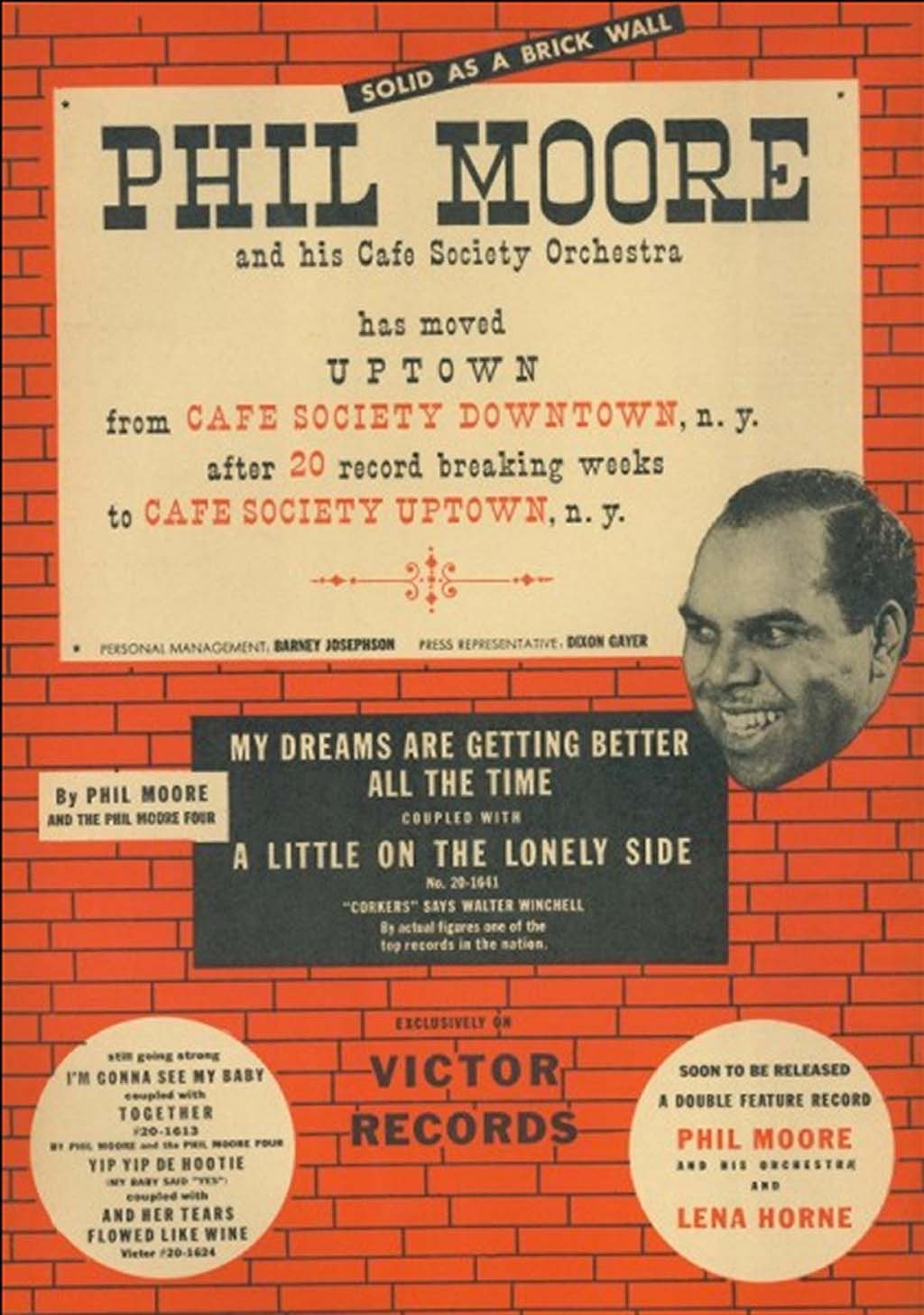
Thanks to the Internet, I was finally able to hear Phil Moore's version of "I'm Gonna See My Baby" with the Phil Moore Four from his earlier stint on RCA Victor Records:


Phil's version is definitely jazzier than Johnny's big band record. I get a strong King Cole Trio vibe, which is a beautiful thing!

Here's "Billboard's" take:


Interesting to know it was his wax bow!

OK, we'll leave  Phil Moore alone for a while!

Wednesday, November 18, 2020

"Chinchy Old Scrooge" - Phil Moore with the Phil Moore Four (1953) - Part 4


While mining the pop culture reference points for Phil Moore's 1953 RCA Victor recording of "Chinchy Old Scrooge," I can't let it pass without pointing out the one person who gets name-dropped...

One particular line goes, "This ain't a fit night out for Clyde McCoy!"

Being somewhat hip by 1953 standards myself, I immediately recognize Clyde McCoy as the embodiment of corny music. He was a popular bandleader and trumpet player who featured the ultimate "wah-wah" sound on his horn. (This circuitously led to the non-corny wah-wah pedal for guitars in the 1960s, but that's another story!)

His type of square music is typical of what the bop cats were rebelling against. The difference between Clyde McCoy as a trumpeter and, say, Dizzy Gillespie is incalculable!

The thing is that I think Clyde McCoy is awesome! I absolutely love his theme song "Sugar Blues." He recorded it a few times, but my favorite is his 1935 version for Decca Records:


I love hipsters vs. squares circa 1953!

Just to provide a bit of context, here are "Billboard" magazine's top ten best selling singles from November 28, 1953, when "Chinchy Old Scrooge" was released:

I know all those records very well and they're not without merit, but they are pretty square!

The spiritual successor to Clyde McCoy is Pee Wee Hunt with his version of "Oh!"


So, are we done with Phil Moore?


Tuesday, November 17, 2020

"Chinchy Old Scrooge" - Phil Moore with the Phil Moore Four (1953) - Part 3

Let's look at a couple of contemporary clippings that give an idea of the reaction to Phil Moore's 1953 coupling of "Chinchy Old Scrooge" and "The Blink Before Christmas" for RCA Victor Records.

The first is a review from "Billboard" of December 12, 1953:


Next is from "Jet" of December 24, 1953:


What I find most interesting is that these both imply that "Chinchy Old Scrooge" is a bop retelling of "A Christmas Carol," which it really isn't. It just uses the Scrooge name as shorthand for somebody stingy, oops! I mean chinchy!

There's no ghostly intervention or anything, although Scrooge does reform. Not that it was meant to be an adaptation and failed in achieving that goal.

The novelty song "Ebenezer Scrooge" also from 1953 (and discussed here) does actually tell the story of "A Christmas Carol" if ever so briefly.

Listening to "Ebenezer Scrooge" and "Chinchy Old Scrooge" back-to-back shows the wide span of releases from major labels in 1953!

I think the "Billboard" review is otherwise spot-on. I think it's meant as a novelty for hipsters, as it's not actually a song.

The mention of Al "Jazzbo" Collins and Steve Allen is in refence to the then-current vogue of spoken-word novelties kicked off with this recording from earlier in 1953:


The picture sleeve and other promotional material show that this was definitely marketed as a collaboration between Allen and Collins, although they started making their own records in the same vein very quickly.


I'm presuming that Phil Moore's record was an attempt by RCA Victor to jump on the bandwagon.

The piece from "Jet" is interesting as well, with the thinking that Moore's record was harmful to children. Imagine what those squares would have thought if they knew what kids listen to these days!


Monday, November 16, 2020

"Chinchy Old Scrooge" - Phil Moore with the Phil Moore Four (1953) - Part 2


If you got a chance to listen to "Chinchy Old Scrooge," the 1953 recording by Phil Moore and the Phil Moore Four, I'm sure you'll agree that it's a fascinating novelty!

I do think it's meant as a novelty as the slang is so thick that you can't imagine anyone ever really sounding quite like that, even the heppest cats in 1953!

The flip side of this single, "The Blink Before Christmas" sheds a bit of light on things. Give it a listen:


The key is Don Burley, Phil Moore's co-writer on this track. Burley was a pianist like Moore, but he was also a journalist and among his accomplishments was "The Harlem Handbook of Jive" first published in 1941.

He included takeoffs of poems and stories including "The Jive Night Before Xmas," based on "A Visit from St. Nicholas" by Clement C. Moore (no relation to Phil!).

It would seem that Phil Moore used Burley's poem as the basis for the "Blink" side and took that inspiration for the "Chinchy" side.

Next, some reactions...

Sunday, November 15, 2020

"Chinchy Old Scrooge" - Phil Moore with the Phil Moore Four (1953) - Part 1


"Chinchy Old Scrooge" (1953) 
Phil Moore with the Phil Moore Four
Songwriter: Phil Moore
RCA Victor Records

We haven't dipped our collective toe into the audio pool in a bit, so let's give a listen to this 1953 recording of Phil Moore performing "Chinchy Old Scrooge" with the Phil Moore Four:


Interesting!

Next: our deep dive into this recording...

Saturday, April 18, 2020

"A Christmas Carol" (1951) - Charles Laughton - Part 4


The 1951 recording of "A Christmas Carol" by Charles Laughton for RCA Victor does not have a long running time, only roughly 16 minutes, so they naturally have to cut a lot from the original story.

As always, the question is what they kept, what they cut and whether they added anything different.

I feel that it's good news that nothing was really added. It really seems that Charles Laughton is reading the book to us, as most of what he's reading is verbatim. I could listen to him just reading the book in the manner that Patrick Stewart did so many years later.

So, what do we have?


Side One starts with Mr. Laughton introducing himself then getting down to things. We hear Scrooge interacting with his nephew Fred and reluctantly giving Bob Cratchit the next day off. Scrooge goes home and sees Marley's face in the knocker and Marley's Ghost appears. Marley's Ghost does go "oooohhh" a lot, as I had mentioned. It's a fun ghostly effect for kids.


Side Two has the Ghost of Christmas Past appear and we're told he's dressed in a white tunic and holding a sprig of holly. The spirit takes Scrooge to Fezziwig's warehouse for the Christmas party and Fezziwig's dancing is described in detail. No Dick Wilkins, though! Then we get the breakup scene with Belle. The past is done and the Ghost of Christmas Present calls out to Scrooge as the side ends.

Now Side Three mostly features the Cratchits' Christmas dinner with Tiny Tim and all. The spirit also conducts Scrooge on a whirlwind tour of other Christmas celebrations. This spirit disappears very quickly and Scrooge is confronted by the phantom that is the Ghost of Christmas Yet to Come!

Side Four needs to wrap it up so we quickly go from the other businessmen to Scrooge's forlorn body to the Cratchits' house without Tiny Tim to Scrooge seeing his own grave. We know the drill, so Scrooge is back with his bedpost. He talks to the boy out the window and we're told he sends a turkey to Bob Cratchit and goes to church. Scrooge is comically mumbling in the background at times. Scrooge beats Bob to the office next morning, raises his salary and Tiny Tim and Mr. Laughton both say that famous line!

So, a pretty quick trip through the story, but still a lot crammed in.

Lots of fun!

Friday, April 17, 2020

"A Christmas Carol" (1951) - Charles Laughton - Part 3


Charles Laughton looms large over RCA Victor's 1951 recording of "A Christmas Carol," as befits his status as an Oscar winning movie star, but there is a supporting cast.

The record album contains a cast list, which is immensely helpful, as how else would we know who played those parts 70-ish years later?

The other actors are not featured much and they're not particularly famous, but they seem to be a bunch of Charles Laughton's associates.


The Scrooge here is not overly forceful and doesn't really sound old enough. He's played by William Cottrell (33 years old at the time), who had been a student of Laughton's and was later his assistant. He doesn't have roles in all that many movies, but he was in "The Man on the Eiffel Tower" (1949), which starred Charles Laughton. The most fascinating thing about him was that he was at one point married to Morganna, the infamous "Kissing Bandit" of the 1970s!


Also appearing in "The Man on the Eiffel Tower" was William Phipps, who was also a protégé of Laughton's. He plays Fred on the recording. He's in a ton of movies and TV shows from 1947 through 2000 with his credits ranging from providing the speaking voice of Prince Charming in Disney's "Cinderella" (1950) to a featured role in the so-bad-it's-almost-good "Cat-Women of the Moon" (1953)!

Harry Burnett made these puppets for Albert Einstein and Gary Cooper. That's just plain awesome!

Then we have Harry Burnett as Bob Cratchit. I presume this is the puppeteer who was an associate of Elsa Lanchester (who was married to Charles Laughton for many years) in Hollywood's Turnabout Theatre.

Non-puppet Coop gives Laughton his due!


The Ghost of Christmas Past is played by Peter Brocco, who also played a ton of mostly small roles over a along career. He also appeared with Laughton in the movies "Devil and the Deep" from 1932 and "Spartacus" from 1960!

Vic Perrin, a prolific radio and voice actor plays Marley's Ghost. I don't know if he has a specific connection to Charles Laughton, but he does the most "acting" here, but it's mostly going "ooooohhh" in the background - in  case you didn't know he's a ghost!


Among his memorable later voice work was several "Scooby Doo" villains and, best of all, Nomad the space probe on the "Star Trek" episode "The Changeling" from 1967. I would not want to run into Nomad, as I'm sure he'd think I'm guilty of plenty of non-sequiturs!

So it would appear to me that Charles Laughton was pretty much given free reign to cast whomever he wanted for this "A Christmas Carol" project. Most of it consists of him reading from the original text, so it's all good.


Also worth mentioning is the producer of the recording, Steve Carlin. He later had an interesting career in TV, executive producing such shows as "The $64,000 Question," most famous of the rigged quiz shows of the 1950s, as well as Jackie Gleason's "You're in the Picture," infamous as the worst game show ever. The first episode was so bad that for the second (and last) episode, Gleason came on to apologize!

How sweet it is... not!

So, a bunch of colorful characters coming together for kiddie record!

Next, what about the plot?

Thursday, April 16, 2020

"A Christmas Carol" (1951) - Charles Laughton - Part 2


If you got a chance to listen to Charles Laughton's 1951 recording of "A Christmas Carol" for RCA Victor, you may have been as surprised as I was that he (SPOILER) does not play Scrooge!

This has a very interesting approach with the star as the narrator but a supporting cast as well. This reminds me most of the 1939 "Campbell Playhouse" broadcast with Orson Welles as narrator, but, of course, that had a strong Scrooge in Lionel Barrymore.

In this case it seems especially unusual to have the narrator say some of Scrooge's lines when there is another actor playing Scrooge.


I think Charles Laughton would have been a really good Scrooge in a big-screen adaptation. He certainly could bring the meanness to it, as most famously evidenced by his portrayal in MGM's 1935 production of "Mutiny on the Bounty." If Bob Cratchit had ever gotten together for a beer with Fletcher Christian and they started complaining about their bad bosses, Bob would have thought he was fortunate!


A good flipside of Charles Laughton's range as an actor is evidenced in anther 1935 film, "Ruggles of Red Gap" from Paramount. He's totally convincing as an English butler out West without a vestige of Captain Bligh in sight.


Throw in "Les Misérables," in which he played Inspector Javert, and 1935 was a really good year!

Laughton's billing: "Co-starring the Mighty 'Mutiny' Man as Captain Kidd"


By 1951, the time of this recording, he was at an interesting career point. The next year he co-starred in "Abbott and Costello Meet Captain Kidd." I love Abbott and Costello and I think Charles Laughton is a blast in that movie, but I can't imagine that he expected to wind up in a movie like that!

Anyway, I like hearing Mr. Laughton read and he's really good at enunciating each word while reading quickly. This needed to be done in order to get as much story as possible into those 16 precious minutes.


I think it's cool that this has a booklet with the text of the recording. The page above seems to indicate that it matches right up. I need to get a complete set of this (at a reasonable price).

The Christmas bells indicating when to turn the page takes me back and I think it's awesome to have the passive aggressive reminder!


If you try to Google "Charles Laughton" and "A Christmas Carol," you'll find that you get many more matches for the Decca Records coupling of Ronald Colman's recording of "A Christmas Carol" and Charles Laughton's "Mr. Pickwick's Christmas." Those two previous recordings were linked the year before (1950) and have remined together ever since!

As a bonus, here's "Mr. Pickwick's Christmas":


My theory is that Decca did so well with that album that RCA decided to fight fire with fire by having Charles Laughton record this set.

Whatever the case, I'm glad they did!

Next, a look at the supporting cast and crew...

Wednesday, April 15, 2020

"A Christmas Carol" (1951) - Charles Laughton - Part 1


"A Christmas Carol" (1951)
RCA Victor Records
Producer: Steven R. Carlin
Scrooge: Charles Laughton

In order to get away from those subpar animated adaptations of "A Christmas Carol," we go back to the 1950s, 1951 to be precise, for an audio recording from RCA Victor featuring Charles Laughton.


Charles Laughton is, of course, a legendary British actor, with many brilliant performances in classic movies, including his Oscar winning portrayal of the title character in "The Private Life of Henry VIII" from 1933.

The particular item we're looking at is from RCA's "Little Nipper" series of records aimed at the kiddie market. Kid's records were big business in those long ago, pre-home video days, so we have some really good projects that we can still enjoy today. This record set had booklet which you could use to read along, as long as you followed Mr. Laughton's instructions!

This was a two-record set (45 or 78 rpm), so we have four sides, each about four minutes long, so not a lot of time to tell the story.

Give a listen to each side below!

Side 1

Side 2

Side 3

Side 4