Showing posts with label Reginald Owen. Show all posts

Tuesday, August 17, 2021

Hmmm...

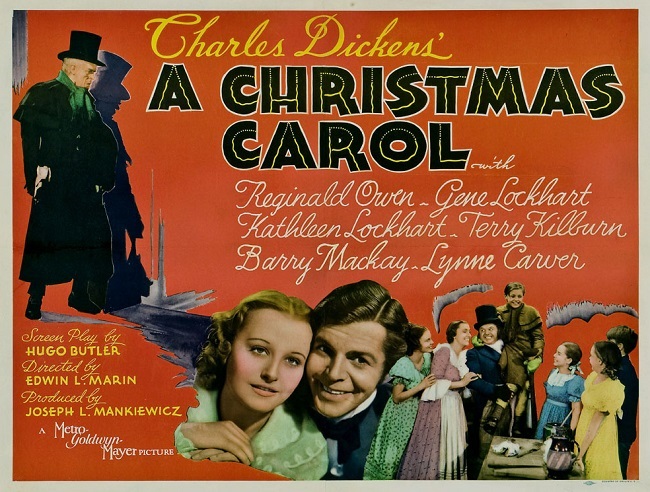
So, this is a poster for the 1962 reissue of MGM's 1938 version of "A Christmas Carol":


Three thoughts:

1. This was a viable theatrical reissue in 1962?

2. The Terry Kilburn is good, but the Reginald Owen is off-model!

3. What's with the old school inset illustration? Nothing to do with the movie! And Ann Rutherford is way better looking than this Ghost of Christmas Past!

That is all! 

Thursday, June 24, 2021

Makeup!

Here's a still from MGM's 1938 production of "A Christmas Carol":


The effect of Leo G. Carroll as Marley's Ghost looks good, but you can really see that Reginald Owen is wearing a ton of makeup! It kind of ends at his chin, leaving his neck un-made-up!

Saturday, December 26, 2020

A Journey Back to 1938


So, around the holidays, TCM always shows MGM's 1938 version of "A Christmas Carol" with Reginald Owen. Certainly makes sense!

I usually either record it or watch it "On Demand" as that's easier than digging out  the DVD or whatever.

This particular version is not overly well-regarded and I have certainly taken it to task, but if I get past what it's not, I do enjoy it as a bit of fluff.

TCM showed it as part of a Dickens block with the David O. Selznick produced MGM blockbusters "David Copperfield" and "A Tale of Two Cities" from 1935 and David Lean's brilliant "Great Expectations" and "Oliver Twist" from 1946 and 1948, respectively.

The 1938 "A Christmas Carol" suffers mightily in such company (1951's "Scrooge" can stand with them), but take it away from those other ones and it's a pleasant diversion.

"All-Star" Barry MacKay's Fred is awesome and Gene Lockhart's Bob Cratchit is outstanding too. They carry the movie, offsetting Reginald Owen's somewhat cartoonish Scrooge and the miscasting of Terry Kilburn as Tiny Tim.

Wait, did I go full-circle and start "dissing" the movie again?

Oh, well...


Saturday, September 5, 2020

"A Christmas Carol" (1938) Lobby Cards


We were just looking at some lobby cards for "Scrooge" (1951), often regarded as the best-ever movie adaptation of "A Christmas Carol," but the 1938 MGM version has long been a major player in the cinematic world.

So, here's some lobby cards from "A Christmas Carol" (1938):


They look good!

Sunday, March 15, 2020

"Good News of 1939" Episode 51 (December 15, 1938) - Part 3


A few things about the MGM/Maxwell House old-time radio show "Good News of 1939" and its adaptation of the 1938 movie "A Christmas Carol."

As I mentioned before, I think they do a good job of representing the movie. I would almost say that I think it works better as an audio drama.

I've never been crazy about Reginald Owen's makeup in the movie, but that's something we don't have to worry about here.

And having Lionel Barrymore as the narrator instead of Scrooge is an interesting twist. We have other opportunities to hear him play Scrooge, so it's not like our one chance was lost.

With Barrymore not able to do the actual movie, however, we did miss our one chance to see him play Scrooge. It's not Reginald Owen's fault, but we have to blame someone!

In any event,  listening to the whole hour-long "Good News" show is another one of those things that seems like a history lesson more than entertainment. I think the show is kind of bloated, like they're trying really hard to entertain you. The music to me is especially over the top. I can easily listen to an hour of records from 1938, but not of this type of music.

I think this was pretty square back then as well!


I do think Robert Young is a good emcee for the show. He was an MGM contract player for quite a while and did some good work for them in some good pictures.


He didn't really hit his stride, however, until he starred in the radio show "Father Knows Best," which led to the long-running TV show of the same name, which established him as a TV star, which later lead to his other successful series "Marcus Welby, M.D."

It's kind of fun that "Father Knows Best" was also sponsored by Maxwell House Coffee on the radio. Did one of the suits remember Bob Young from the "Good News" show?

I also remember his commercials for Sanka coffee, which were on quite often when I was a kid. Did he have to switch to decaf after all that Maxwell House?


I think it's fun that the announcer is Warren Hull, who started acting more over the next few years. He played the lead in "The Green Hornet Strikes Back" serial from 1940, as well as "Mandrake the Magician" and "The Spider's Web" serials. He was pretty good in those, but being a serial star didn't often lead to bigger and better acting parts. He eventually found a niche as host of the TV show "Strike It Rich" in the 1950s.

The comedy chores on "Good News" were handled by Frank Morgan and Fanny Brice and they were apparently quite popular with the listening audience, as they wound up outlasting the show, starring on "Maxwell House Coffee Time" after the MGM association was dropped.


Frank Morgan is best-known (only known?) these days for his title role in "The Wizard of Oz," but he was a versatile actor for MGM.

I don't think his radio act holds up well, though. He's a likeable performer, but the material is dated.


Fanny Brice, on the other hand, is still funny as Baby Snooks. At this point in time she was a 47 year-old playing a five or six year-old. It shouldn't work, but it does. Hanley Stafford does yeoman work playing her Daddy and the two of them work quite well together. Fanny wouldn't have been able to pull off the act on TV, but that shtick was perfect for radio. Radio was awesome for letting you form your own pictures in your mind.

If you're curious, here's the Baby Snooks sketch from this same episode of December 15, 1938:


We're fortunate that a number of episodes of the "Good News" radio show were preserved and it's fun to hear the MGM stars, but it's definitely an artifact of its time.

Funny thing, though... Now I have the urge to buy some Maxwell House K-cups!

Saturday, March 14, 2020

"Good News of 1939" Episode 51 (December 15, 1938) - Part 2


Did you get a chance to listen to the portion of "Good News of 1939" containing the preview of MGM's 1938 version of "A Christmas Carol?"

I think it's pretty good. Lionel Barrymore could easily have played Scrooge here, as he sounds in good form, but since Reginald Owen stars in the film, he plays the part here and Barrymore is the narrator. I like his narration quite a bit.

We also have Gene and Kathleen Lockhart, Ann Rutherford and Ronald Sinclair reprising their roles from the movie.

Ronald Sinclair had a couple of snappy co-stars in "Thoroughbreds Don't Cry" (1937).


I notice that Ronald Sinclair is not "big" enough to be mentioned in the opening. I think he's a pretty good young Scrooge, though. He really only gets a couple of lines here.

Since this sketch is meant to promote the movie, it follows it pretty closely, although they have to cut a lot out.

Fred does not appear at all, although Bob mentions him at the end, and we don't have the charity solicitors. It's also interesting that in the Christmas present sequnce, we don't hear any of the Cratchits speak, so while we hear about Tiny Tim, we never actually hear him. That makes it a bit awkward when Lionel Barrymore quotes him at the end, but I bet most listeners didn't think much about it.

What we do get, however, is the sequence of Bob getting "sacked" for ruining Scrooge's hat, which really makes you know you're listening to an adaptation of the movie!

One thing to remember is that the "Good News" show is meant to promote MGM movies as in make you want to go see them, so this sketch ends with Scrooge pleading for a second chance. You have to go see the movie if you want to know how it ends!

Franz Waxman also did the score for "Bride of Frankenstein" (1935)!


All in all, I think it's a good representation of the movie. I recognized Franz Waxman's music, which was a plus for the movie and sounds really good here.

Next, some additional thoughts...

Friday, March 13, 2020

"Good News of 1939" Episode 51 (December 15, 1938) - Part 1


"Good News of 1939" Episode 51 (December 15, 1938)
Director: Edward L. Marin
Scrooge: Reginald Owen

We head back 20 years from Stan Freberg to visit the old-time radio show "Good News of 1939," which was a co-venture between MGM and Maxwell House to promote movies and sell coffee. And both of those goals were accomplished!

So, why are we talking about this show? Well, when the episode of December 15, 1938 rolled around, the movie MGM needed to promote was... "A Christmas Carol!"

That is, of course, the version starring Reginald Owen, who had taken over the role when Lionel Barrymore was incapacitated.

Lionel is here to narrate the proceedings, which is fun.

The whole show is an hour long with material that doesn't necessary hold up or at least suit our purposes, so I edited it down to about 20 minutes to showcase the movie adaptation.

Give it and listen, then we'll break it down...


Friday, December 27, 2019

Santa Claus Funnies (1942) - "A Christmas Carol" - Part 2


A couple of things I thought when reading the "A Christmas Carol" story from Santa Claus Funnies (1942)...

I think they did a really good job of condensing the story into 15 pages. It's not dumbed-down either, although the presumed audience was children.


I was kind of worried that Fred wouldn't be in it, as he didn't appear at the beginning, but he actually is represented relatively well. He does look just like Bob Cratchit, though!


It's cute that Tiny Tim was the one who was wondering where Martha was and that he was so excited to see her.

But it's some of the character design that I found most interesting.


A lot of the artwork is off-model, but in some panels, Scrooge looks just like Reginald Owen. Understandable, as that famous 1938 movie was just a few years before.


The craziest thing, though, is that the Ghost of Christmas Present looks like the one from that 1949 made-for-TV version hosted by Vincent Price! What's up with that? It can't be coincidence, can it? The plot thickens...

Saturday, October 26, 2019

A Christmas Carol (1938) - Who's Who


Now let's take a look at the cast of the 1938 MGM version of "A Christmas Carol."


First up, Reginald Owen as Scrooge. He's OK, but doesn't seem all that mean and reforms extremely quickly. Granted, that's the script and direction, but I don't think he adds much. He does have an iconic Scrooge look, but sometimes you can really see the heavy makeup!


As mentioned previously, Bob Cratchit gets an expanded role here. That's a good thing as Gene Lockhart does a great job in the role. He has tons of Christmas spirit! I know the knock on him is that he looks like he hasn't missed too many meals, so he doesn't seem poor, but what're you gonna do? He's a total pro  and was in a lot of movies over the years. His other Christmas classic movie claim to fame is his part as the judge at Kris Kringle's hearing in "Miracle on 34th Street" (1947). Not too shabby!

A fun thing is that Gene Lockhart's wife, Kathleen Lockhart, was also a performer and she was cast here as Bob's wife. No name given to her in the book or in this adaptation. She does a good job, but her role is much smaller.


Even more fun is that the Lockharts' 13 year old daughter, June, appears here as Belinda Cratchit! June Lockhart of course was later famous for her roles in the TV series "Lassie" and "Lost in Space." She's recognizable here in  her film debut. She guesses that Bob brought home sausages for Christmas dinner!

So, what about that other Cratchit kid, Tiny Tim? Well, he's played here by Terry Kilburn, who's not an unappealing performer (I've seen him elsewhere, most notably in "Goodbye, Mr. Chips" from 1939), but he just seems wrong here. Too old, too healthy looking. He's just not, you know, tiny!

This movie has the full complement of six Cratchit kids, including Martha and Peter. They all kind of run around screaming a lot, in the manner that adults think that kids act. They remind me of a Victorian Brady Bunch!


Scrooge's nephew Fred also has a greatly expanded role here too. What about the actor, Barry Mackay? Best. Fred. Ever. I don't know who he is, as I've never seen him in another movie (his filmography is small), but he does a great job here. Fred's supposed to have the most infectious personality of anyone you've ever met, and this Fred does!

Fred's not married yet in this version, but he has a fiancee named Bess. The actress, Lynne Carver is attractive, but she doesn't really get a lot to do.


Marley's ghost is played by Leo G. Carroll, whom I've seen in a zillion things, all they way up through "The Man from U.N.CL.E." TV series and he always seems about the same to me, including here. The idea of your former partner's ghost visiting you is pretty scary, but he doesn't add much more. He kind of groans more than moans, I guess.


The Ghost of Christmas Past might have the most interesting casting in the whole movie. While many versions tend to feature an old man, here the ghost is a beautiful young woman, as played by Ann Rutherford. She's the one actor who seems like she was cast because she was hanging around the MGM lot. This was around the time she started playing "Polly Benedict" in the "Andy Hardy" movies. The Christmas past sequence seems very short, but she does just fine.


Interesting casting for young Scrooge too. As mentioned before, we only get one young (and he is young) Scrooge. The actor, Ronald Sinclair, is a young teenager and it's interesting to see someone so young as Fezziwig's apprentice. Dick Wilkins is young here too. Is that actually more period authentic than the twenty-somethingish apprentices we're used to seeing?

Ronald Sinclair appears in a few movies as a teen actor (including playing young Ronald Colman in "The Light That Failed" (1939) - fun!), but switched to the other side of the camera as an adult. He eventually worked as a sound editor on "Die Hard" (1988)! So, does that also give him two Christmas classics on his resume?

To me, the cast is not peppered with familiar character actors the way a lot of MGM movies of the period are, for whatever reason, but the other parts are adequately played. Except for "Fran!" She's as annoying as her name change!

All in all, I think the cast does a good job with the material they're given, with Scrooge and Marley's ghost particularly watered down, but a superior Bob and Fred in the bargain!

Still worth a watch, and it's a snappy 69 minutes!

Thursday, October 24, 2019

A Christmas Carol (1938) - What It's not!


A Christmas Carol (1938)
Director: Edwin L. Marin
Scrooge: Reginald Owen

OK, first off - that tagline? Greater than "David Copperfield." Ummm, no!

Now that we've taken a look at the well-regarded 1951 adaptation, next up is the less-regarded 1938 version.

Back in the prehistoric days of no home video and before the more recent glut of "A Christmas Carol" adaptations, there were two old black & white versions you'd see on TV. You'd have to catch them when they were on, but they would definitely be on.

It may not be fair, but naturally you had to compare the two. It was Reginald Owen vs. Alastair Sim and Sim always won in a unanimous decision!

I always thought that the 1938 version produced by MGM and starring Reginald Owen as Scrooge was lacking something. It's OK and I was always glad to have another version, but it's just a bit lightweight.

So, it got me to thinking what does this not have? (We'll talk about what it does have later.)

The obvious thing to me is that is does not have a strong Scrooge to dominate the proceedings. I've seen Reginald Owen in a bunch of MGM movies from that same period and he seems like a fine, versatile character actor. Not a star, though. I'm not sure if he ever had another lead role. The billing on that poster is telling. He's listed with everyone else without any kind of star billing.

I also think that while his makeup gives him a good Scrooge look, iconic in fact, you can tell it's makeup!

Who should have played he role instead?


Well, in a perfect world, it would have been Lionel Barrymore. By this point in time, he had already established a reputation for playing Scrooge in annual radio adaptations. He was also a "star" character actor. Someone who could carry a movie without being a romantic lead. So, this was a perfect opportunity.

Unfortunately, this movie was going into production about the same time that illness and accidents left Lionel Barrymore confined to a wheelchair. So, he was out. You can convince just about anybody that Barrymore would've been a great Scrooge by telling them that he played "Mr. Potter" in "It's a Wonderful Life." Anybody can totally see it!

Publicity for the movie said that Barrymore was sorry he couldn't play the role, but personally recommended his good friend Reginald Owen, but if you believe old studio publicity, there are many things I'd like to sell you!

We also don't get an all-star cast of supporting actors. Not to say the supporting cast isn't good, but it's not full of well-known actors, even by 1938 standards. If Barrymore had been able to star in the movie, would it have elevated the status of the production and got us a better known supporting cast? Who knows?

There's a pretty fun trailer for the movie with Lionel Barrymore himself telling us all about the movie. The hyperbole is understandable. Check it out...


But MGM can't help but invoke their earlier successful Dickens adaptations, both from 1935, "David Copperfield" and "A Tale of Two Cities." Is this a fair comparison? Well, since they brought it up...

This adaptation of "A Christmas Carol" comes nowhere close to those classics. It's not nearly as ambitious and only runs a little more than an hour, where both of the others exceeded two hours. Granted the source material is shorter in length too, but still...


The big difference is that the earlier films were produced by David O. Selznick for MGM. They were big budget affairs with lavish production values and large casts of star actors and character actors.

After these triumphs, Selznick started his own independent studio and continued to produce such top pictures as "The Prisoner of Zenda," "Gone with the Wind," Rebecca," etc. He was apparently done with Dickens adaptations, however.

So, it gets me thinking what if David O. Selznick had produced a version of "A Christmas Carol" back in the 1930s, either with MGM or independently.

I can see, say, Ronald Colman (superstar of "A Tale of Two Cities" who later played Scrooge on records and radio) as Scrooge with Freddie Bartholomew (breakout child star of "David Copperfield") as Tiny Tim. How's that for thinking big?

Well, now we know what we don't have, so what do we have?