Showing posts with label Rich Little. Show all posts

Friday, December 4, 2020

"A Christmas Carol" All-Star Team - Day 4


As we put our All-Star team together, the next character we run across is young Scrooge's fellow apprentice: Dick Wilkins!

I find Dick Wilkins to be an interesting side character and always wondered what his backstory was (granted he's a fictional character).

All we now about him is what Scrooge says in the book:

“Dick Wilkins, to be sure!” said Scrooge to the Ghost. “Bless me, yes. There he is. He was very much attached to me, was Dick. Poor Dick! Dear, dear!”

What does he mean by that?

I recall that in some version, Scrooge says, "He died so young," or something to that effect, but I can't remember which one, and that would be non-canonical.

In any event, the most memorable representation of young Mr. Wilkins to me is Rich Little impersonating Gregory Peck from Rich's 1963 LP "Scrooge and the Stars."


I think it's awesome to have a spot-on imitation of a huge, Oscar-winning movie star in a throwaway bit!


Wednesday, June 10, 2020

Rich Little: 1963 vs. 1978


Since we just reviewed the "Rich Little's Christmas Carol" 1978 TV special and had previously reviewed his 1963 LP "Scrooge and the Stars," the natural thing to do now is compare them!

SPOILER: I prefer the earlier LP for a number of reasons.

I think a project like this works better in audio form, as you can picture the "celebrities" in your mind as you hear the voices. With the video, you're at the mercy of how close the makeup artists could make Rich Little look like the celebrities.

I find that I can lose myself better in the illusion of audio. I'm a big fan of Old-Time Radio anyway, so I'm no stranger to the theater of the mind.

I thnik the material is a bit stronger on the LP as well. Both projects credit Rich Little as the sole writer, so it's a fair fight.

My retro mindset also makes me like the 1963 pop culture refences more than the 1978 ones.

And, last but not least, the LP is about half as long as the TV special. For a novelty, Mr. Shakespeare was not lying when he wrote, "Brevity is the soul of wit."

Still, some fun to be had with both projects.

Next!

Tuesday, June 9, 2020

"Rich Little's Christmas Carol" (1978) - Part 4


Since “Rich Little’s Christmas Carol,” the 1978 HBO special, is actually a full-fledged adaptation of the story, so we need a breakdown of the plot elements.


There’s about fifty minutes to the show, some of which is taken up by musical numbers, such as the opening “The Merriest Christmas Yet,” but there’s still plenty of time for the story.


The musical numbers are OK but seem a bit tacked on. And the singing is so cheerfully sanitized, it makes the Ray Conniff singers seem edgy!


This is a reasonably faithful version, with the biggest change being in the nature of Scrooge’s business. It’s a “Boat and Bottle” business, in which Scrooge drinks the contents of the bottles and Bob Cratchit puts boats in them. It’s an odd concept, but tied to the running them of the Scrooge/W.C. Fields character having a fondness for the grape.


The rest of the introductory scenes are largely what you’d expect, although the story elements are mainly used as a structure upon which to hang the impressions and jokes. Clearly you're supposed to be already familiar with the basic story.


A small difference is that Scrooge and Cratchit argue over Bob wanting to burn wood to keep warm, rather than coal. The idea’s the same, though. Cratchit jumps around to stay warm and sings a bit of “Stayin’ Alive,” so the Brothers Gibb made some money on the deal!


Fred and the charity solicitors make their appearances with plenty of shtick.


Scrooge goes home and see Marley’s face in the knocker and an interesting little touch is that Scrooge’s nose glows bright red as he enters his house and goes up to his room.


Marley’s Ghost appears and warns Scrooge, with the Richard Nixon impression dominating the scene.


The Ghost of Christmas Past appears and takes Scrooge back to Fezziwig’s Boat and Bottle business for the Christmas Party. Fezziwig runs around a lot while participating in a musical number about office parties.


Dick Wilkins actually gets the type of dialogue that Fed would usually get, if Fred hadn’t have been too busy doing his monologue earlier. Scrooge and Dick do a duet. This implies that Scrooge was already miserly back then.


This is the only scene from the past, then Scrooge is back in bed, repeating “Money… money…” in his sleep, as did Jack Benny/Scrooge on Rich Little’s 1963 LP “Scrooge and the Stars.”


The Ghost of Christmas Present then comes along to take Scrooge to Bob Cratchit’s house, where they see the Cratchit family with their Christmas dinner. The meagerness of the feast is played up for comedy purposes.


This scene has actual kids playing the Cratchit kids and they speak a bit.


Since Tiny Tim is “played” by Truman Capote, the spirit mentions that Tim wants to be a writer, but will die if Scrooge doesn’t help.


That’s the only scene from the present, so the Ghost of Christmas Yet to Come is next. He talks in this version, which is mainly to make use of the “Inspector Clouseau” character.


They see the other businessmen talk about Scrooge then visit the cemetery. The slapstick is really played up here, as the clumsy spirit keeps falling in Scrooge’s open grave.


Scrooge promises to reform, and part of the deal is for him to give up alcohol.


Scrooge then winds up back in his room and talks to the kid out the window and gets him to buy the turkey to send to Bob Cratchit.


Scrooge goes out in the street and buys gifts during another musical number, then proceeds to Fred’s house.


Fred is doing another monologue, then welcomes Scrooge as there’s more singing and Scrooge drinks a glass of milk.


The next morning has Scrooge surprising Bob at the office, where he makes him his atoner and they have a buttermilk toast.


Scrooge being unable to drink the contents of the bottles would pose a problem to the business, but this is rectified by the new employee. We don’t this employee, but we hear him singing “Everybody Loves Somebody,” so we know the bottle emptying job will be in the capable hands of Dean Martin!


The end is very odd, as Rich Little as the various characters thank Rich Little. Huh?


Amusingly, though, the last shot is the graveyard, where we see the tombstone of Charles Dickens keel over!


One more thing I have to mention is the laugh track. I don’t like it. I’m not against laugh tracks unless they sound phony and this one does. Among other issues, there was obviously not an audience present as they taped this.


All in all, this is an interesting period piece that could be sued as a time capsule for those interested in late-1970s pop culture or those feeling nostalgic.


For average modern audiences, it would probably just seem weird.


Monday, June 8, 2020

"Rich Little's Christmas Carol" (1978) - Part 3


Rich Little's impersonation of W.C. Fields as Scrooge dominates the proceedings of 1978's "Rich Little's Christmas Carol," but Rich also adds a lot of supporting characters.


Bob Cratchit is “played” by Paul Lynde, a familiar TV figure at the time. He was best-known as the center square on the “Hollywood Squares” TV show, where he always had a snappy answer. He was a popular target of impressionists because of his distinctive manner of speaking that made everything sound somewhat sarcastic.


I don’t think there’s any particular reason for Paul Lynde to be Bob Cratchit, it’s probably just because Rich Little does a good Paul Lynde. This would seem to indicate that anything goes.


That would be borne out by having Johnny Carson as Fred. Rich Little did a great Carson and gives it his all here, with all of Johnny’s mannerisms. He makes his entrance to the actual “Johnny’s Theme,” which shows this production doesn’t skimp on music fees.


The two scenes with Fred have him give a monologue of sorts, complete with jokes that bomb. Johnny Carson was often funnier when a joke didn’t go over, as he’d playfully “curse” the crowd. We even get a “Carnac the Magnificent” bit thrown in.


Modern viewers who don’t know Paul Lynde or Johnny Carson will have no idea what’s going on, but anybody watching this in 1978 or so would have been amused.


The charity solicitors come in next and like W.C. Fields, they’re more of the “classic” variety. There are two of them, so why not have them be Laurel & Hardy? I think Rich Little does a pretty good Stan, but I’m not sold on his Ollie. I think Stan’s easier to do. The hair bugs me, as it's just Rich Little's 1970s hairdo with bowlers plopped on.

They use a rare split screen effect for L & H.


Marley’s Ghost is played by another Rich Little specialty, one Richard M. Nixon, the (fairly) recently disgraced president. He’s the only character to be in modern dress (a business suit) and his “chains” are reels of tapes. At the time audiences would know that meant the Watergate tapes, especially after he mentioned that the interval between the first and second ghosts would be 18 ½ minutes!


The Ghost of Christmas Past is played by Humphrey Bogart, another long deceased (1957) star. He was (and is) still well-known at the time and Woody Allen’s “Play It Again, Sam” movie had come out a few years before in 1972. Hey, even Peter Brady imitated Bogie while saying, “pork chops and applesauce!”


This Bogart seems mainly to be "Sam Spade" from “The Maltese Falcon” (1941), but his introduction quotes “Casablanca” (1942) and he also throws in a “Fred C. Dobbs” reference from “The Treasure of the Sierra Madre” (1948). Rich Little does a good Bogart.


The Christmas Past sequence features Groucho Marx as Fezziwig. Groucho had passed away the year before this special was made, but this is the younger, movie Groucho (hairdo not withstanding). I don’t think Rich Little nails it, though. I’m a huge Groucho fan and I think he’s easy to imitate, but hard to really nail.


Dick Wilkins gets perhaps his most screen time in any adaptation and he’s represented by Jimmy Stewart, another long-standing Rich Little staple. He and Scrooge even sing a duet! There does not appear to be any attempt to make Rich look like Jimmy Stewart, but the impersonation is excellent.


The Ghost of Christmas Present is next up and he’s the TV character "Columbo," as played by Peter Falk, That’s to say it’s a Columbo impression, not Peter Falk per se. Rich is spot-on with his imitation, using that passive-aggressive overly solicitous Columbo thing.


At the Cratchit house things get really wacky, as Mrs. Cratchit is "Edith Bunker," the character portrayed by Jean Stapleton on the “All in the Family” TV Show. I don’t think it’s a good imitation, but it’s so wacky that it’s funny.


Even wackier, but in a disturbing way, is Tiny Tim, who’s represented by Truman Capote. What’s weird is that when Bob Cratchit is carrying him home, it’s an actual kid on Rich Little’s shoulder, but then Rich in the close-ups. Creepy and not funny.


The Ghost of Christmas Yet to Come also wears a trench coat like the other spirits, this time because he’s Inspector Clouseau, the clumsy French detective payed by Peter Sellers in “The Pink Panther” series of films, which were still being made at that time. I don’t think this is a strong impression either and goes overboard on the slapstick. We do hear Henry Mancini’s “Pink Panther Theme” to sell it, though!


The three businessmen talking about Scrooge in the future are three of Rich’s strongest impersonations: John Wayne, George Burns and James Mason. All three had been featured on his earlier “Scrooge and the Stars” LP from 1963.

Who wore it better?

The John Wayne one is odd, as he’s in full cowboy gear. I’m not sure how he should be dressed, but it’s jarring. As with L & H, what bugs me the most, though, is the cowboy hat is just plopped down on Rich Little’s usual hairdo.


I would have expected the George Burns character to look like the then-current version of Burns from “The Sunshine Boys” (1975) and “Oh, God!” (1977) with big, round glasses and all. He looks more like the early TV Burns, which was so not relevant in 1978.


James Mason had just been in the smash movie “Heaven Can Wait” (1978), so that impression was still viable. Rich had made his American TV debut on “The Judy Garland Show” in 1964. As I understand it, Judy approved the hiring because she liked his James Mason impression, as she had co-starred with Mason in 1954’s “A Star Is Born.”

There's no attempt to make Rich Little look like James Mason and I don't think he's particularly well-known these days, so that's a tough one for the uninitiated to guess.


The final celebrity to be impersonated is Jack Benny as the window boy. Rich always did a good Benny and had used him as Scrooge on his 1963 LP. Jack had passed away in 1974 but was still well-known in 1978.

The Benny character plays "Love in Bloom" on his violin and wears a beanie and appears to be "shrunken" to make him look like a kid.

Of note, the only "stars" to get billing in the opening are W.C. Fields, Paul Lynde, Richard Nixon, "Edith Bunker" and John Wayne. Why? Who knows!


So, it’s an interesting mix of celebrities being impersonated, some current, some past.

If nothing else, it’s time capsule of what audiences were expected to recognize in 1978.

One thing with Rich Little playing all the main roles (there are extras) is that he needs to interact with himself, so there must have been a ton of editing involved.


We mostly get close-ups with quick cuts, but here and there some split screen shots are used. Sometimes, though, they rely on the technique of using a body double where you see the back and can't quite see the face.


This always makes me think of "The Patty Duke Show" in which Patty played "cousins... identical cousins" and you often saw one from behind while she talked to the other. This always looks fake to me as you never see that shot on shows otherwise. Like you didn't see only Chip's back when he was talking to Robbie on "My Three Sons," say.


You can also say they're "Fake Shemps," as used in the Three Stooges shorts pieced together after Shemp Howard passed away. That's when there's a stand-in used who never quite gets in the picture.

Whatever the case, the techniques generally work here, with  the glaring exception of an actual child standing in for Tiny Tim/Truman Capote. Creepy!

Next, what about the plot?

Sunday, June 7, 2020

"Rich Little's Christmas Carol" (1978) - Part 2


Let's take a look at the "cast" of "Rich Little's Christmas Carol," the HBO TV special produced in 1978.

I was around then and very aware of the pop culture at the time, so I do feel qualified to rate Rich's choices and the impressions thereof.

One thing that strikes me as compared to his "Scrooge and the Stars" LP from 1963 is that the LP featured celebrities who were largely relevant at that time, or at least still living (including JFK).

The TV special, however, features a number of deceased celebrities, including some who were probably gone before Rich Little started his professional career.

Some of the other impressions are very much of their time.

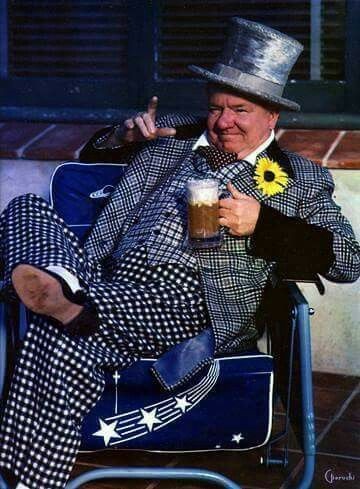
We start with Scrooge himself, whom Rich plays as W.C. Fields. This is an interesting choice, as Fields had passed away in 1946, when Rich Little was only eight years old.


W.C. Fields was always a popular target for impressionists, however, and his cantankerous persona seems pretty Scrooge-like. The best remembered trait from his comedic persona (and real life?) was his fondness for adult beverages and that is exploited heavily here.

I had a couple of those erasers!


I remember W.C. Fields having a resurgence in the 1970s, when he was viewed as a counter-culture figure. They also used to have a "W.C. Fritos" character selling that snack product in animated TV commercials and the big-budget film "W.C. Fields and Me" (1976) starring Rod Steiger.


So, my basic point (if I have one) is that W.C. Fields as Scrooge in 1978 is not as anachronistic as it might seem at first glance.

This casting also brings up an interesting question: How would the real W.C. Fields have been as Scrooge in a big-screen adaptation of "A Christmas Carol" in the 1930s?

I think that would have merited some consideration.


Fields had memorably played Mr. Micawber in MGM's famous adaptation of "David Copperfield" from 1935, so he had shown that he could fit in the Dickens world and demonstrated that he had acting chops beyond his comedy roles - though he was a great comic actor.

What if MGM had enlisted Fields for their 1938 version of "A Christmas Carol" when Lionel Barrymore was unable to play Scrooge? That would have given it some zip! I've read that MGM had considered Fields for the title role in "The Wizard of OZ" (1939), so he was on their radar.

Back to reality: Rich Little does a solid W.C. Fields and the makeup does make him look the part.

Next, the rest of the "cast"...


Saturday, June 6, 2020

"Rich Little's Christmas Carol" (1978) - Part 1


"Rich Little's Christmas Carol" (1978)
Director: Trevor Evans
Scrooge: "W.C. Fields"

We time hop gain this time landing in 1978 for "Rich Little's Christmas Carol," a videotaped special of Canadian origin which used to run on HBO back in the day.

As might be surmised from the title and using the earlier discussed LP "Scrooge and the Stars" from 1963 as a clue, this features Rich Little performing all the parts in "A Christmas Carol" while imitating celebrities.

It's a big jump from his earlier LP, as the video nature requires Rich to be made up to resemble the celebrities as best they can and also have some trick photography so he can interact with himself.

If you've never seen it, you can check it out below:


Saturday, May 9, 2020

"Scrooge and the Stars" (1963) - Rich Little - Part 4


Since Rich Little's 1963 LP "Scrooge and the Stars" is actually a reasonably faithful adaptation of "A Christmas Carol," I feel it's my duty to review what plot points and incidents from the original book were included. And I'm not one to shirk my duty!

There are plenty of bits of comedic business thrown in, but there's actually a fair amount of dialogue straight out of the book and there really aren't any incidents that did not come from the book.

The two sides total about 25 minutes which really seems to be the norm for an audio adaptation, whether it was a half-hour radio show or an album of 78 rpm records. Since this one started as a 33 1/3 rpm LP, it could have been twice as long, but I suppose you don't want such a novelty to overstay its welcome.

The plot structure of this adaptation is pretty typical in that it hits upon most of the popular incidents.

Which is it?

After the introduction, Scrooge is at his office where he counting his trading stamps. The narrator (Fred McMurray) says they're Gold Bond Stamps, but Scrooge later says they're Green Stamps, which are not the same. Hmmm...

"Horace?"

We have Scrooge and Bob Cratchit arguing about coal, then Scrooge's nephew drops in, followed by the charity gentleman. The Alfred Hitchcock one calls the Jimmy Durante one "Horace." I'm not sure if there's any significance to that name. I feel like I get most of the jokes on this recording, but I don't know if that's a joke.

Anyway, Scrooge goes home and sees Marley's face in the knocker. The bit with the caroler has been moved from Scrooge's office to his home. It's a funny bit, though, as the caroler is Bing Crosby and Scrooge says a couple of time that he'll never amount to anything as a singer!

Marley's Ghost comes in and his exchange with Scrooge gets in all the needed details, despite his being represented by John Wayne. It's interesting to think of Jack Benny and John Wayne being partners in anything!

The Ghost of Christmas Past and Scrooge briefly go back to where Scrooge was a boy. Curiously, the narrator says it's a open country road and Scrooge says he was born on that very spot. I don't know if that's a joke or just awkward scripting.


After that, they go to Fezziwig's warehouse, where Fezziwig has young Ebenezer and Dick Wilkins prepare for the party. Dick tells Ebenezer to get his fiddle, so he must be providing the music. A rare case of someone actually requesting Jack Benny to play!

We don't actually hear the party and at this point Scrooge brings up the caroler. That's usually done when they see Scrooge as a lonely boy, but that particular scene wasn't included here.

That ghost vanishes and Scrooge is sleeping when he's awakened by muffled voices in the next room. The Ghost of Christmas Present is JFK and he tells Peter, Bobby and Frankie to be quite. I presume that's Lawford, Kennedy and Sinatra, respectively.

They go to Bob Cratchit's house and we just hear muffled voices representing the Cratchit family, except for Tint Tim's one line, which sounds like Liberace, but, as mentioned, is not credited as one of the impersonations. The muffled voice which would probably be Bob's does not sound at all like "Rochester."

I need Perry Mason to solve this mystery!

They also go to Fred's where he toasts Scrooge. In this scene, one of the guests is Raymond Burr and he grills Fred in a "Perry Mason" manner. I'd say the imitation is really Perry Mason. Anyway, it sounds like Burr/Mason calls Fred "Tom Paine" or something like that. I know Thomas Paine wrote the "Common Sense" pamphlet in Colonial times, but this reference is over my head, if that's indeed the reference. I'll have to think about this one some more!


After he's finished with the present, Scrooge meets the Ghost of Christmas Yet to Come, who talks in this version, which is rare but not unheard of. It's rarer still that he sounds like Ed Sullivan, but you can never have enough Ed Sullivan imitations!

The ghost and Scrooge hear the businessmen discussing Scrooge's death and then they see his gravestone. Scrooge begs for mercy and winds up back in his own bed.

Scrooge calls out the window to "Chester" and sends him to buy the turkey, which Scrooge says he'll send it to Bob Cratchit. He then starts counting his trading stamps again!

The narrator tells us that Scrooge goes to church, makes a large donation to the poor and goes to Fred's for dinner.

Then we have Scrooge beating Bob to the office the next morning and raising his salary.

The narrator comes back for the wrap-up and Tiny Tim reappears for his line, which the narrator acknowledges.

At this point, I say, "Aha! That's exactly how the Lionel Barrymore record ends!" In fact, the last part about going to church, etc. seem inspired by that as well. I think for a second that the whole thing might have used that 1947 MGM studio recording as a template, but except for the end, it really doesn't.

On the whole, we actually have a faithful adaptation with a lot of little embellishments to show off the impersonations and add humor.

I think the whole thing is fun and since it's audio only, you can get lost  it and think you're really hearing all those celebrities.

Rich Little returned to this idea off and on and wound up taping an HBO special in which he also visually impersonates the celebrities. We'll take a look at that later.

Friday, May 8, 2020

"Scrooge and the Stars" (1963) - Rich Little - Part 3

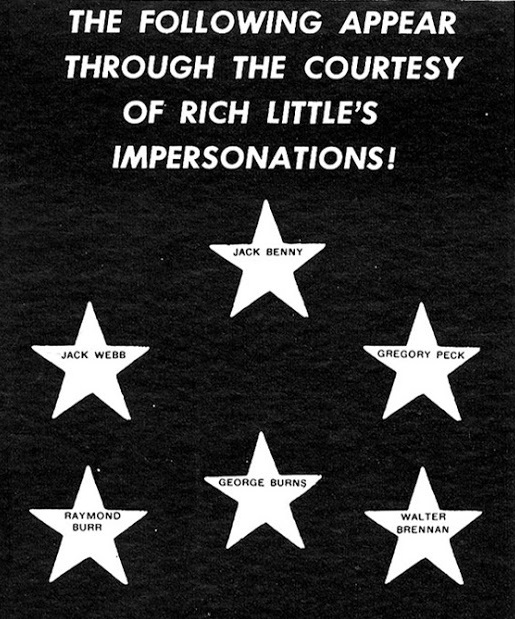
You can enlarge the picture to see the stars!


Rich Little's 1963 album "Scrooge and the Stars" featured John F. Kennedy was the Ghost of Christmas Present, but it also had a bunch of other celebrities, all from the entertainment world.

Being an aficionado of retro pop culture, I'm familiar with all of the performers and feel reasonably qualified to judge the impersonations.

It's an interesting mix, with a lot of them having been prominent for quite some time, but still around in 1963, including Bing Crosby, Jimmy Durante, George Burns, John Wayne, etc.


This is also true of the "star" of the recording, Jack Benny. He's a great choice to be cast as Scrooge for a comedy project, as his stinginess was the dominant trait of his show-biz persona. By all accounts, he was a very generous man in real life, but everyone thought he was stingy. Throw in his perpetual claim of being 39 years old and his violin playing and there's plenty of comedy fodder.

I'm a huge Jack Benny fan and I think Rich Little nails the impersonation. You start thinking you're actually listening to Benny himself and that's as good as it gets!

Jack seems reluctant to pay "Rochester" his 15 shillings!

Since you need to have a Bob Cratchit, it's extremely helpful if your Scrooge "actor" already has a put-upon employee. In this case we have Jack Benny's longtime valet "Rochester" in that role. His real name was Eddie Anderson, but he was usually just billed as "Rochester," as he is here, or sometimes Eddie "Rochester" Anderson. It was a common radio practice for actors to be billed as their character names and the public seemed to think they really were who they played on the radio. Fans thought Rochester was actually Jack's valet. Whatever the case Eddie Anderson was a great performer with one of the most memorable voices ever. And unlike Cratchit, "Rochester" was usually one step ahead of his own boss.


The narrator of the piece is Fred MacMurray, who's not the first star you think of as being a target for impressionists, but he was very popular at the time with the "My Three Sons" TV series and movies such as "The Absent-Minded Professor" (1961) and "Son of Flubber" (1963). Rich Little's impersonation is excellent, so good that it probably was a factor in having "Fred" narrate.

Rich also does a great Jimmy Stewart and John Wayne and I remember them being staples of his act back in the day, so it's no surprise to see them here, along with the mandatory Ed Sullivan.

A couple of the stars seem odd choices to me, mainly Van Heflin and Dana Andrews. I've seen both of them in tons of movies and enjoy their work, but I'm not sure what made them relevant in 1963 as they were never huge stars.


Gregory Peck was huge star, of course, and had just won the Best Actor Oscar for "To Kill a Mockingbird" (1962), so that's definitely the most star power ever associated with Dick Wilkins!

And Jackie Gleason is a fun Fezziwig!

Jack Webb is here although "Dragnet" was in between TV incarnations. Everybody would still "get" that impersonation, though, as Sgt. Friday was very memorable. Raymond Burr is in full "Perry Mason" mode here and the over-the-top Walter Brennan, à la "The Real McCoys" is awesome!

He passes the Lucy Van Pelt test!

Fascinating to me is that "Chester" from the TV series "Gunsmoke" is billed as the celebrity, rather than Dennis Weaver. It seems like a throwback to Rochester and such. Looking back, I associate Dennis Weaver with "McCloud" as much as "Gunsmoke" and I also remember him from the "Gentle Ben" TV series. But in the early 1960s, he must have just been Chester!

I know Chester was big as he's the only celebrity namedropped by the Chipmunks in their 1960 recording of "Chipmunk Fun." Alvin even throws a little imitation of him!

Just for fun, here's that record:


We have a few other celebrities in the mix, but the mystery here is why whoever "plays" Tiny Tim does not get billing. I think it's Liberace, though. Anyone have any thoughts?

So lots of fun impressions and Rich Little's talent is just off the charts. No wonder he was going to make inroads into U.S. prominence soon!

Next up, the obligatory plot breakdown...


Thursday, May 7, 2020

"Scrooge and the Stars" (1963) - Rich Little - Part 2


If you got the chance to listen to Rich Little's 1963 album "Scrooge and the Stars," I'm sure you'll agree that it's something!

I had always known that Rich Little was Canadian, and at this point in time he was well-known in his home country, but had not appeared yet on American TV and I don't think this album saw an American relase, although every star that gets imitated was known to American audiences.

One thing that worked against this album was an issue that no one could have anticipated. The Ghost of Christmas Present was "played" by John F. Kennedy and this album was released in Canada right about the time that JFK was assassinated. Bad timing for any hope of Americans enjoying this album.

A couple of quotes from "JFK" that come from the book (more or less) are poignant in retrospect. He says, "My life upon the globe is brief. It ends tonight. As a matter of fact, it ends as quickly as you can say your name."

Kind of eerie as well, but now that 50-odd years have passed, you can think, "Hey, he did a pretty good JFK!"

The album on the left was out, the album on the left was in.


I presume not many people in America was aware of Rich Little's album anyway, but he certainly fared better than American comedian Vaughn Meader, who had a quick rise to fame impersonating JFK on "The First Family" comedy album in 1962. There was no market for such a thing a year later.

To show what comes around goes around, in 1981 Rich Little headlined a new album in that series, "Then First Family Rides Again," which spoofed the newly elected Ronald Reagan and featured Vaughn Meader in a small role.

But what about the other celebrities on the "Scrooge and the Stars" album?

We'll talk about them next!

Wednesday, May 6, 2020

"Scrooge and the Stars" (1963) - Rich Little - Part 1


"Scrooge and the Stars" (1963)
Capitol Records
Performer: Rich Little
Scrooge: "Jack Benny"

Here we have another novelty record from the early 1960s, but this one's a full-length album adaptation of "A Christmas Carol," as presented by famous impressionist Rich Little in 1963!

Rich Little is, of course, extremely famous, probably the most famous impressionist ever. And with good reason, as his talent is remarkable. His voices are excellent, but he was also always really good at picking up on the impressionee's mannerisms.

These talents serve him well here, as he imperonates "22 well known personalities in a modern version of 'A Christmas Carol'"

So, give a listen:

Side 1


Side 2