So, I was watching the 1938 MGM version of "A Christmas Carol" again, as I do every holiday season.
This time, however, I noticed that TCM had the Descriptive Video Service option for the move, so I turned it on, as I think it's kind of an interesting way to watch (hear) something you've seen before.
I raise my hand to admit that I never noticed, until the narrator mentioned it, that the sign for Fezziwig's warehouse has the first initial of "J" included?
I spend so much time nitpicking the movie that I guess I just have overlooked it all these years!
I had previously made an effort to watch movies featuring Barry MacKay, who portrayed Fred in MGM's 1938 version of "A Christmas Carol," as for years I only knew him from that one role.
So, when the 1937 MGM movie "Thoroughbreds Don't Cry" popped up on TCM, I thought I should take a closer look at Ronald Sinclair, who was featured in that film and also played young Scrooge for MGM the next year.
"Thoroughbreds Don't Cry" is basically a programmer, but just about any MGM film from the 1930s has good productions values and good performers and this is no exception.
The most notable thing from an historic standpoint is that "Thoroughbreds Don't Cry" is the first movie in which both Judy Garland and Mickey Rooney appear!
That combination of stars is one of the greatest in movie history, but it's more happenstance that they're both in this movie, as they don't play opposite each other, if you will, and only interact in a couple of scenes. They do work well, together. though!
Judy is billed first in the cast listing, which would be the only time she was billed over Mickey, but Mickey wasn't quite MICKEY ROONEY yet.
The lead role in the movie is actually played by Ronald Sinclair and he's the (puppy) love interest for Judy here and he's also the first actor you see on screen at the start of the credits!
That may seem odd to have an unknown such as Ronald featured so prominently, but as you watch the film, it's obvious that he's playing a part that was meant for the then-popular Freddie Bartholomew.
As I understand it, Freddie had an aunt who was his guardian and said aunt often locked horns with the MGM brass. Presumably MGM had "Thoroughbreds Don't Cry" ready to go as a vehicle for Freddie with up-and-comers Mickey and Judy in support, but had to cast a different lead due to aunt trouble!
With this in mind, the trailer for the movie is quite intriguing:
Freddie was back in the fold to film the trailer. I don't buy for a second that he's happy that his "pal" is in the movie instead of him, just as I don't buy that Lionel Barrymore handpicked Reginald Owen to replace himself as Scrooge!
Whatever the case, I think Ronald Sinclair is very good in "Thoroughbreds Don't Cry," holding his own against Mickey and Judy, but I guess MGM didn't need him once they smoothed things over with Freddie Bartholomew, as his only other appearance in an MGM film is in the small role of young Scrooge.
As for "Thoroughbreds Don't Cry" itself, it's a fun movie, only about 80 minutes long, so it doesn't outstay its welcome. I don't know if I'd say it's a "gripping drama of extraordinary goodness," though!
This is only Judy Garland's second film for MGM, following her breakthrough role in "Broadway Melody of 1938," and she's quite delightful. Oddly, she only gets one song, "Got a New Pair of Shoes," but she sings that one song multiple times!
As I mentioned, Mickey Rooney wasn't a big star yet, but you can see this kid had the goods. I kind of prefer him in the somewhat-shady secondary roles he played before the "Andy Hardy" persona took over, but he was good in whatever role he played.
Sophie Tucker plays Judy's aunt and she tosses off some great one-liners. I understand that she wasn't pleased with the direction in which MGM was pushing her (i.e. non-singing Marie Dressler-type parts), but she's a pro and interacts quite well with the kids.
Sir C. Aubrey Smith plays Ronald's grandfather and he's always awesome, but I don't think his title drop from the trailer is in the movie!
And one more thing as evidenced by the poster at the top of the page. For such a prestigious studio, MGM had dreadful artwork on their theatrical posters!
It's not really my intention every time I watch MGM's 1938 version of "A Christmas Carol" to wonder who should have been cast as Ebenezer Scrooge rather than Reginald Owen (since Lionel Barrymore), but I do wonder!
Throw in that I recently was listening to Charles Laughton's 1951 recording of "A Christmas Carol" for RCA Victor on which he did not portray Scrooge and it occurred to me...
What if MGM had cast Mr. Laughton as Scrooge in their movie?
I had mentioned before that Laughton could be very evil (1935's "Mutiny on the Bounty") or kind (1935's "Ruggles of Red Gap) so he could easily handle the before and after Scrooge characterizations.
And since "Mutiny on the Bounty" was an MGM production, their hype machine could say "It's Charles Laughton at his 'Mutiny on the Bounty' evil best!" or "You thought he was mean as Captain Bligh? Wait until you see him as Scrooge!"
If they had gone that route, it would be a bigger production with a longer running time and the story would have more meat and not be so fluffy.
As such, you throw in more of Scrooge's past, such as his doomed engagement to Belle. And who plays Belle? Laughton's real-life wife, Elsa Lanchester!
For visual reference as to how Charles Laughton might have looked as Scrooge, we merely have to turn to 1939's "Jamaica Inn":
That movie takes place in the 1820s, roughly the same period as "A Christmas Carol," so you can totally see it!
While I'm throwing things out there, here's another thought...
Producer Selznick (left) and director Hitchcock.
What if former MGM producer David O. Selznick, who had produced 1935's Dickens blockbusters "A Tale of Two Cities" and "David Copperfield," was involved in the production of a late-1930s "A Christmas Carol" and had imported Alfred Hitchcock to direct it? (Selznick brought Hitch to America to direct "Rebecca" (1940) following "Jamaica Inn," Hitchcock's last British film of the time.)
So, as I often often do, I was looking for a movie to watch on TCM and settled on "Listen, Darling," a 1938 release from MGM.
I had seen it years ago and remembered some of it but not so much as not to be entertained.
Anyway, what caught my eye was that this film was directed by Edwin L. Marin, who was also the director of "A Christmas Carol," another 1938 release from MGM!
This sort of thing makes me start thinking about context (my big thing) and how do those two movies relate and whatnot.
One thing to note is that Edwin L. Marin was the director of five MGM releases that year, which shows that he was efficient, if nothing else, and that he couldn't have spent much time on "A Christmas Carol," so that was not a big "prestige" picture.
I've enjoyed quite a few movies on his résumé, so I'd say he had talent to go along with his efficiency, so a valuable employee in the days when studios were churning out a lot of movies.
The other common thread of "Listen, Darling" and "A Christmas Carol" is that Gene Lockhart appears in both films.
He, of course, plays Bob Cratchit in "A Christmas Carol" and adds a lot to that movie. His role in "Listen, Darling" is smaller, but puts the plot in motion.
The plot (such as it is) of "Listen, Darling" is Judy Garland and her friend Freddie Bartholomew trying to find a suitable husband for Mary Astor, Judy's widowed mother, so she won't have to marry the "drizzle puss" played by Gene Lockhart!
Gene's character is named "Mr. Drubbs" (which has a Dickensian sound to it!) and is just as dull as his name. Gene plays the part very well and comparing this to his performance as Bob Cratchit shows his versatility.
Gene Lockhart is the only actor to appear in the two movies, but I started to wonder if anyone else in "Listen, Darling" would fit into "A Christmas Carol."
The obvious first thought is Freddie Bartholomew, the young British breakout star of MGM's earlier Dickens adaptation of "David Copperfield" from 1935. I think he would have been a good Tiny Tim if MGM had adapted "A Christmas Carol" a couple of years earlier, but even by 1938, Freddie was age 14 and not tiny enough anymore. Not that I think Terry Kilburn was ideal, but don't get me started!
If MGM had wanted to use Freddie in "A Christmas Carol," the best part would have young Ebenezer Scrooge, but that role would have needed to be expanded and it would have thrown everything off by having a box office name (which Freddie had been and sort of still was) play young Scrooge while a non-box office name (Reginald Owen never was) as old Scrooge.
The only other British actor in "Listen, Darling" was Barnett Parker, who plays his typical role of a butler. He could have been shoved into any number of small parts in "A Christmas Carol" if he had been hanging around the lot.
The romantic lead of "Listen, Darling," Walter Pidgeon, was Canadian, but sort of seemed British, but I don't think there was a good role for him in "A Christmas Carol," except maybe Fred, but he was perhaps too mature for that part.
Not British in the least was Alan Hale, who also appears in "Listen, Darling," but I submit that he could have been a great Ghost of Christmas Present, had things lined up that way!
Another thing to note is that Judy Garland also appeared in another 1938 MGM movie directed by Edwin L. Marin, "Everybody Sing," and her father in that movie was played by Reginald Owen and her sister by Lynne Carver ("Bess" in "A Christmas Carol")!
Everything comes back around!
From a non-"A Christmas Carol" standpoint, "Listen, Darling" is pleasant entertainment showing Freddie Bartholomew just after his peak of stardom and Judy Garland just before hers was to begin!
Here's the trailer for "Listen, Darling," which tells you all you need to know:
So, this is a poster for the 1962 reissue of MGM's 1938 version of "A Christmas Carol":
Three thoughts:
1. This was a viable theatrical reissue in 1962?
2. The Terry Kilburn is good, but the Reginald Owen is off-model!
3. What's with the old school inset illustration? Nothing to do with the movie! And Ann Rutherford is way better looking than this Ghost of Christmas Past!
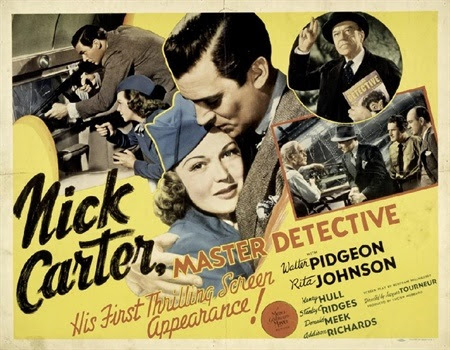
Since we were just listening to the old-time radio show "Nick Carter, Master detective," a few words about the character and his origins seem to be in order.
One interesting point is that Nick Carter's debut actually predates that of Sherlock Holmes, by a little over a year (1886 vs. 1887)!
Nick was never as famous as Holmes, but was still pretty famous and spanned a lot of media.
First were his adventures in the newspapery "New York Weekly' followed by "Nick Carter Weekly" as published by Street & Smith through 1915.
By the 1930s, Street & Smith was publishing pulp magazines such as "Doc Savage" and "The Shadow," so Nick Carter was revived with his own title.
Then there was a series of three MGM films from 1939-1940 starring Walter Pidgeon as Nick in an early leading role for him prior to his big breakthroughs in the Oscar-wining Best Pictures "How Green Was My Valley" (1941) and "Mrs. Miniver" (1942).
Then of course was the radio series "Nick Carter, Master Detective" (aka "The Return of Nick Carter") starring Lon Clark as Nick and running on the Mutual Broadcasting System from 1943-1955.
Meanwhile, Nick also appeared in "Shadow Comics" headlined by his Street & Smith and MBS stablemate.
Skip ahead a bit to the James Bond inspired spy craze of the 1960s and we had the emergence of Nick Carter - Killmaster!
This series ran for 261 novels from 1964-1990. Proof you can't keep a good literary property down!
One word of caution: if you want to research this character, make sure you include the word "detective" in your search to avoid boy band drama!
I know I've mentioned a number of times that I really enjoy Barry MacKay's performance as "Fred" in MGM's 1938 version of "A Christmas Carol."
I've also said that I didn't know him from any other movies.
So I thought I would rectify that with a crash course on him, and we'll call it "Barry MacKay 101!"
I had noticed when doing my All-Star team that the only other movie listed among his credits that I had ever seen was "Knights of the Round Table" (1953), another MGM movie.
Well, "Knights" popped up on TCM recently, so I checked it out. I hadn't seen it in quite some time, but I remember liking it and I'm glad to say it holds up! Robert Taylor, 20ish years into his MGM contract, easily carries the picture as Sir Lancelot. He and Ava Gardner (as Guinevere) are about as good-looking a couple as 1953 had to offer!
Anyway, armed with the knowledge that Barry MacKay is unbilled as "Green Knight's Squire," I was ready to go!
A while into the movie, Lancelot encounters a couple of varlets who refer to each other as "squire" although neither one looks like Barry to me. But their master is indeed a knight who's dressed in green!
Another quick peek at the IMDB shows another actor, Derek Tansley, also credited as "Green Knight's Squire," so there are two squires. One of them must be Barry!
Wait a minute, where's that rewind button?
OK, a look at Derek Tansley's head shot indicates that he's definitely the squire on the left. So, that means the other is Barry MacKay!
Studying things closely, I can sort of see that it's him, but I never would have picked him out otherwise. I get a strong Oliver Hardy from "Babes in Toyland" vibe!
It had been 15 years since "A Christmas Carol," but how come Robert Taylor still looks like he did in 1938?
So, around the holidays, TCM always shows MGM's 1938 version of "A Christmas Carol" with Reginald Owen. Certainly makes sense!
I usually either record it or watch it "On Demand" as that's easier than digging out the DVD or whatever.
This particular version is not overly well-regarded and I have certainly taken it to task, but if I get past what it's not, I do enjoy it as a bit of fluff.
TCM showed it as part of a Dickens block with the David O. Selznick produced MGM blockbusters "David Copperfield" and "A Tale of Two Cities" from 1935 and David Lean's brilliant "Great Expectations" and "Oliver Twist" from 1946 and 1948, respectively.
The 1938 "A Christmas Carol" suffers mightily in such company (1951's "Scrooge" can stand with them), but take it away from those other ones and it's a pleasant diversion.
"All-Star" Barry MacKay's Fred is awesome and Gene Lockhart's Bob Cratchit is outstanding too. They carry the movie, offsetting Reginald Owen's somewhat cartoonish Scrooge and the miscasting of Terry Kilburn as Tiny Tim.
Wait, did I go full-circle and start "dissing" the movie again?
We were just looking at some lobby cards for "Scrooge" (1951), often regarded as the best-ever movie adaptation of "A Christmas Carol," but the 1938 MGM version has long been a major player in the cinematic world.
So, here's some lobby cards from "A Christmas Carol" (1938):
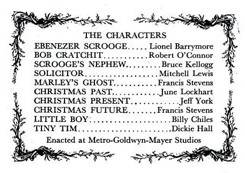
The LIFE magazine photo spread from the December 25, 1944 issue featuring Lionel Barrymore as Scrooge is a fascinating piece.
It offers something of a "what if" in that it perhaps shows what a movie featuring Barrymore as Scrooge would have looked like. He famously did not get the chance to play the part in 1938. I may have mentioned that once or twice!
The story indicates it was enacted at the MGM studios, so the photos do look movie-ish.
They show the cast list, which is really helpful, but it's not a particularly well-known bunch, with a couple of exceptions.
Who wore it better?
Most fascinating of all is June Lockhart, who's made up to look like Ann Rutherford's version of the Ghost of Christmas Past from the 1938 movie.
June is best-known for her later TV "mom" roles on "Lassie" and "Lost in Space," but if you recall, she played Belinda Cratchit in the 1938 movie with her real-life parents Gene and Kathleen Lockhart!
She no doubt remembered that, but did whoever was casting this photo shoot know? Pretty fun, though!
June's still around, age 94!
I also recognize Jeff York, well his name, as the Ghost of Christmas present. He was a big guy who originally acted in serials and B-movies under his sort-of birth name Granville Owen, then changed his name after service in WWII to Jeff York. I imagine he was going for a Bruce Bennett thing, as Herman Brix broke away from the stigma of serial acting by changing his name.
In any event, it got him signed to MGM, which is how he wound up here. I remember him most as Mike Fink in a couple of "Davy Crockett" episodes on the Disney TV show. From reruns of course!
I have to look on he IMDB to identify any of the other "actors," but they seem to be MGM contract players. I don't think any of them would have been cast in an actual live-action version of "A Christmas Carol" if it were to have been made in 1944, except maybe for Dickie Hall as Tiny Tim.
In any event, it all works well for these purposes.
The photography by Ralph Crane is great, but no surprise as he was very accomplished. If you Google him, you'll see all sorts of great photos.
My editor likes this one!
Old LIFE magazines have fun ads in them, including some for products that don't exist anymore. I'd buy this one, though: