

A place for all things related to my OSD (Obsessive Scrooge Disorder)!
Showing posts with label George C. Scott. Show all posts
Showing posts with label George C. Scott. Show all posts
Friday, August 18, 2023
Lego My Scrooge!
Don't know who made this custom Lego of George C. Scott as Scrooge:
 But I admire their dedication!

Saturday, April 16, 2022
More TV!
Here's another TV GUIDE ad:

This is from 1985, so it would be the second airing.
My main takeaway is that I didn't realize they were doing closed-captioning that far back!
Saturday, July 24, 2021
Soundtrack!
This soundtrack album released long after the initial release of the 1984 George C. Scott TV-movie looks intriguing:


Nice cover!
The CD seems to have had a limited pressing in 2017.
Word is that it's really good, but there are a lot of inferior products that confuse the issue.
For example, on Amazon, it looks like there are reviews from other albums mixed in and if you try to steam it, it redirects over to the soundtrack for the 1999 Patrick Stewart TV-movie!
Oh, well!
Monday, May 31, 2021
"A Christmas Carol Christmas Book" (1984) - Stave Five
We wrap up 1984's "A Christmas Carol Christmas Book" featuring stills from George C. Scott's TV-movie with Stave Five:

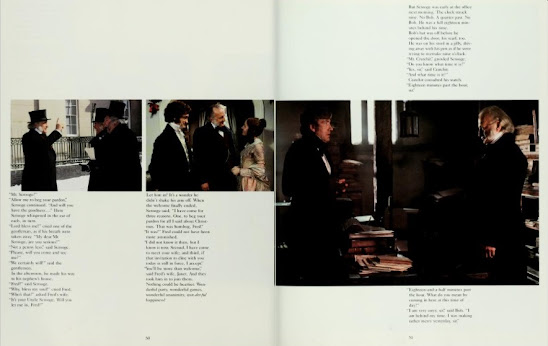


Pretty cool book on the whole but more of a curiosity than anything!
Sunday, May 30, 2021
"A Christmas Carol Christmas Book" (1984) - Stave Four
Time for Stave Four:


These stills are very atmospheric!
Saturday, May 29, 2021
"A Christmas Carol Christmas Book" (1984) - Stave Three
We're up to Stave Three of "A Christmas Carol Christmas Book" from 1984 with more stills from the TV-Movie:


Edward Woodward was a really good Ghost of Christmas Present!
Friday, May 28, 2021
"A Christmas Carol Christmas Book" (1984) - Stave Two
Next is Stave Two of "A Christmas Carol Christmas Book" from 1984 with stills from that year's TV-movie starring George C. Scott:


I think these pictures represent the story and the special well.
Thursday, May 27, 2021
"A Christmas Carol Christmas Book" (1984) - Stave One
Now we're ready to start looking at the different staves from "A Christmas Carol Christmas Book" so we can enjoy the stills from the 1984 TV-movie.
So, here's Stave One:


Pretty fun!
Wednesday, May 26, 2021
"A Christmas Carol Christmas Book" (1984) - Introduction

"A Christmas Carol Christmas Book" (1984)
Armonk (New York)
Text: Tim Hallinan
Photography: David James
We turn from the edition of "A Christmas Carol" illustrated with scenes from the 1982 animated feature to another book similarly illustrated, but this one had still from the celebrated 1984 TV-movie starring George C. Scott!


The cover of the book gives the source away and this book does acknowledge that the scenes are from said special.
Here's the little blurb:

Kind of hyperbole. I guess they're saying that "Scrooge" from 1970 (being in color) wasn't filmed on location and that "Scrooge" from 1951 is less faithful. Kind of odd brags!
The mention of the "first section" of the book refers to this thing going "Uncle Toby" on us with a bunch of other chapters devoted to other Christmas traditions.
Here's the table of contents:

Here's a sample chapter page:

Very interesting that they use the same picture of Charles Dickens that the last book did!
Here's a nice montage of the cast from the TV-movie:

Next, we do the inevitable stave-by-stave breakdown!
Sunday, December 22, 2019
The Scrooge Look

While talking about the 1999 made-for-TV adaptation of "A Christmas Carol" starring Patrick Stewart, I mentioned that I didn't think he had a Scrooge "look."
That got me thinking about which actors in the role did have the look and whether that helped them in our acceptance of them as Scrooge.

Starting at the top, I do think that Alastair Sim has a pretty good Scrooge look. Certainly he's well-accepted in the role. The funny thing is that he doesn't have unusual makeup or a very different hairstyle. He always looks that way!
I imagine most people that know him at all today only know him as Scrooge. They like him, but may be underrating him as an actor. If you see him in another movie, such as 1946's "Green for Danger" (which is a good one), you realize that he looks and sounds the same as he does in "Scrooge," but the character is totally different. That's just good acting!

Moving ahead to Albert Finney, he has makeup to make him look older and more Scroogy and he affects a wacky voice. He's certainly far removed from how he looks as young Scrooge. I think he gives a terrific performance, but he's helped by the makeup and voice.

George C. Scott sounds the same as he usually did, but he had ginormous mutton chops to make him look more Scroogish. Also, his general reputation for being, shall we say, mercurial makes casting him as Scrooge a non-stretch. But he certainly delivers the goods.

Even Mister Magoo seemed well-cast as Scrooge and didn't need to change his appearance too much to be convincing. The brilliant voice acting of Jim Backus certainly helps too!

Sir Seymour Hicks is a great Scrooge, but there's not really much of a point of reference of how he might have been otherwise, so it's easy to accept him as Scrooge.

Fredric March was a great actor with two Oscars on his mantel, but he definitely needed makeup to look like Scrooge, as he still looked like a movie star in 1954.
So, props to Patrick Stewart for doing it au natural, if you will, and pulling it off!
Sunday, November 24, 2019
Sim and Finney and Scott! Oh, my!
When discussing that 1984 TV-movie from 1984 starring George C. Scott, I mentioned that I had put him in a "Big Three" of Scrooges along with Alastair Sim and Albert Finney back in the day. They didn't really have an awful lot of competition at the time, but newer adaptations have come along and older ones have resurfaced, so it's a more crowded field. But, I still say those three are the best!
It's intersting to compare and contrast their interpretations, as they each give the role a different spin.
I think that Albert Finney and George C. Scott are at the extreme ends of the Scrooge spectrum. Finney plays the role very broadly and really emphasizes the eccentric aspect of being a miser. He's a bit crazy on the whole and really does a 180 when he reforms. He embraces his new philanthropy with the same vigor that he had when trying to collect debts! It's a borderline comic performance.
George C. Scott, on the other hand, emphasizes the businessman aspect of Scrooge. He's obsessed with money, to be sure, and wants to have as much of it as possible. But he doesn't seem the least bit crazy or even eccentric. Just a really tough businessman. When he reforms, he's still somewhat reserved, which is in keeping with the performance, which is not comic at all.
So, how does Alslatair Sim fit in? Quite well, I think. He's kind of splits the difference between the other two. He seems a bit odd, but not totally off the wall like Finney. And he's a tough businessman, but not quite as ruthless as Scott. I think is what serves to help make him the ideal Scrooge.
I do think that these guys all had good scripts to work with and solid supporting casts to play off of, but they run the show.
They are all very convincing as Scrooge, but I think that George C. Scott may have had more of a handicap in making audiences think of him as Scrooge in that I believe he was the most recognizable at the time.
Alastair Sim was never a star in America and is really only known now because his Scrooge was so good. In 1951 (or since) American audiences can easily believe he's Scrooge because you don't know him anyway.
Albert Finney was well-known in 1970, but he had the advantage of old-age makeup and a wacky voice to make him seem like Scrooge.
George C. Scott was very well known in 1984 and most of the people tuning in knew him from other roles, especially General Patton. He has the mutton chops, but otherwise looks and talks the same as usual. So, he needed to act like Scrooge to convince us he was Scrooge.
By the same token, his generally perceived persona and "difficult" reputation made this seem like ideal casting, so I guess he had that going for him!
In any event, those are my top three, with Quincy Magoo in his own category.
What do you think?
It's intersting to compare and contrast their interpretations, as they each give the role a different spin.
I think that Albert Finney and George C. Scott are at the extreme ends of the Scrooge spectrum. Finney plays the role very broadly and really emphasizes the eccentric aspect of being a miser. He's a bit crazy on the whole and really does a 180 when he reforms. He embraces his new philanthropy with the same vigor that he had when trying to collect debts! It's a borderline comic performance.
George C. Scott, on the other hand, emphasizes the businessman aspect of Scrooge. He's obsessed with money, to be sure, and wants to have as much of it as possible. But he doesn't seem the least bit crazy or even eccentric. Just a really tough businessman. When he reforms, he's still somewhat reserved, which is in keeping with the performance, which is not comic at all.
So, how does Alslatair Sim fit in? Quite well, I think. He's kind of splits the difference between the other two. He seems a bit odd, but not totally off the wall like Finney. And he's a tough businessman, but not quite as ruthless as Scott. I think is what serves to help make him the ideal Scrooge.
I do think that these guys all had good scripts to work with and solid supporting casts to play off of, but they run the show.
They are all very convincing as Scrooge, but I think that George C. Scott may have had more of a handicap in making audiences think of him as Scrooge in that I believe he was the most recognizable at the time.
Alastair Sim was never a star in America and is really only known now because his Scrooge was so good. In 1951 (or since) American audiences can easily believe he's Scrooge because you don't know him anyway.
Albert Finney was well-known in 1970, but he had the advantage of old-age makeup and a wacky voice to make him seem like Scrooge.
George C. Scott was very well known in 1984 and most of the people tuning in knew him from other roles, especially General Patton. He has the mutton chops, but otherwise looks and talks the same as usual. So, he needed to act like Scrooge to convince us he was Scrooge.
By the same token, his generally perceived persona and "difficult" reputation made this seem like ideal casting, so I guess he had that going for him!
In any event, those are my top three, with Quincy Magoo in his own category.
What do you think?
Saturday, November 23, 2019
A Christmas Carol (1984) - Part 4

As you may have guessed, now it's time to run down some of the particulars of the 1984 TV adaptation of "A Christmas Carol" and see what they do and don't do...
We start of with a bit of narration to establish that Marley is dead. We don't know it yet, but (spoiler) the narrator turns out to be Fred!
 |
| Cratchit causes Scrooge to the hands to forehead bit! |
At the office, Bob Cratchit is the one who mentions that Marley died seven years ago. Scrooge gives Bob a big speech about how coal burns, but clothing lasts, so shut about about being cold and put on more layers!
Scrooge's nephew comes in and they go through the usual banter about Christmas. Scrooge specifically mentions that Fred's wife is poor and had now dowry to bring to the marriage.
Scrooge sure talks about money a lot!
As in most adaptations, Fred and Bob seem pretty well-acquainted. This is so prevalent that you'd really think it was the case in the original text.

When Scrooge leaves his office, we get a couple of scenes that I think are unique to this version. He meets Tiny Tim out in the street. As in the book and probably every other version, Scrooge is completely unaware that Bob has a sick child until the Ghost of Christmas Present beings him to Bob's house. Here he becomes aware of Tiny Tim, but is unimpressed. He even makes a smart alecky remark that Tim will have a long wait for his father to be finished with work!
In the next scene, we see Scrooge at the Exchange, where he drives a really hard bargain over the price of corn. This seems to indicate that Scrooge is some sort of trader, rather than strictly a money lender. Interesting to see him in action. He's ruthless!

When leaving, he encounters the two gentlemen collecting for charity, to whom he gives a less than warm greeting. They're given names here, Poole and Hacking, for whatever reason. They know he's Scrooge, not Marley, which is why Bob had to mention that Marley had been dead for seven years.
On his way home, he sees a ghostly hearse in the street, rather than on his staircase. We hear Marley call him, but I'm not sure if he's in the hearse. Whatever the case, it's different in that Scrooge gets a taste of Marley's Ghost before seeing him in the door knocker. Which he does when he gets home.

When in his chambers, he also sees multiple little Marley faces in his fireplace tiles, a detail from the book which we almost never see. Interestingly, when Marley enters the room, he unlocks all the locks on the door and walks in, rather than passing through, as most ghosts like to do.
He tells Scrooge that the ghosts will all be coming that night. The first at 1:00 am, the second at 2:00, then with an awesome made-up line not in the book, "The third, more mercurial, shall come in his own time." Marley leaves out the window, but we don't see any other phantoms.
Next up, what do these spirits have to show Scrooge?
Friday, November 22, 2019
A Christmas Carol (1984) - Part 5

Now Scrooge is ready for his first spirit - the Ghost of Christmas Past.
It's a woman who emits a lot of light and carries around the requisite extinguisher cap.

First stop, as usual, is to see lonely, young Ebenezer at school. As mentioned before, Scrooge does not weep for his past self, even though the ghost says he can. He's defiantly proud of himself.
Scrooge specifically says that his father held a grudge against him because his mother died in childbirth. This is a throwback to the 1951 version. And to make this work, Fan is apparently older than Ebenezer, although he still calls her "Little Fan." When the ghost reminds Scrooge that Fan's son is his nephew, Scrooge refers to him as "Fred Holywell," so Fred finally has a last name!

When Fan comes to bring Ebenezer home, things get really interesting, as their father came along! I think this might be the only adaptation where we see him, and it's awesome! This guy totally looks like he'd be Scrooge's father and the Ebenezer apple did not fall far from the tree. The credits say the father's name is Silas Scrooge (what else would it be?), but I don't think there's any reference to that in the show itself.
The look on current Scrooge's face as he stares at his father is worth the price of admission alone. Did I mention that George C. Scott is good?
Scrooge Senior sends Ebenezer off to apprentice with Fezziwig in pretty short order, and we visit the big Christmas party next. It looks like young Scrooge and Dick Wilkins are moving bolts of fabric to make room. It's not always clear what Fezziwig has going on in that warehouse!
As is so often the case, Belle is at the party, although this time it's implied that she's not Fezziwig's daughter, as Scrooge identifies three young girls as Fezziwig's daughters - with really young suitors.
Young Scrooge and Belle are good together.

After the party, Ebenezer is talking to Dick Wilkins and Dick says that Ebenezer's not good enough for Belle, which makes Ebenezer resolve to get rich so he'll be worthy. So, was all this Dick Wilkins's fault? If he had shown encouragement to Ebenezer, would he have married Belle and been happy? Thanks a lot, Dick Wilkins!
Current Scrooge says that to start making money, he lent out the sum that he had inherited from his father. Belle was none too pleased, and, as expected, breaks up with him.
Flash forward to married Belle with her ton of kids and Scrooge wonders what he missed out on. He quickly snaps back to his regular self when Belle says she feels sorry for him, so he's mad again and dispatches the ghost!
She doesn't go quietly, however, as she shouts "Truth lives" over and over as she fades away. OK, got it, truth lives.

Now, the Ghost of Christmas Present appears, but curiously, he doesn't identify himself, nor does Scrooge ask who he is. He does refer to the previous ghost as "Christmas Past," however, like it's her name!
The ghost brings Scrooge to the market place, which Scrooge enjoys, as there's lots of buying going on. Oops! Wrong lesson!

Let's go to Bob Cratchit's house. Martha's already there but doesn't talk about her work or hide when Bob comes in. They have all six kids here. Bob calls the youngest girl "Alice" when serving the food, so with Martha and Belinda accounted for, all the girls have names. We also have Peter and Tiny Tim, but the middle boy doesn't get a name. He shouldn't feel too bad, though, as Mrs, Cratchit doesn't get a first name either. I thought that was interesting, as they're pretty free with handing out names in this one!
An extra bit thrown in is that when Peter is to start working, his boss will be Fred Holywell!
Scrooge is more interested in Tiny Tim this time around, but, oh, is he annoyed when the ghost throws that "surplus population" remark back at him! He also gloats when Bob raises the toast to him.
On the whole, Scrooge thinks it's nice that the Cratchits are having a good time, but he's pretty antsy and keeps wanting to leave.
He has a somewhat better time at Fred's house. Fred's wife was in line when they were handing out names, and she came away with Janet. Scrooge talks back to Fred and Janet a lot and is unamused when he's the comic answer to the simile "tight as..."

After the party, they see a poor homeless family with a very meager Christmas meal. This scene may be unique to this version as well. It illustrates whom Scrooge so offhandedly would send to the prisons and/or workhouses he so glibly speaks of. The couple scored the names Ben and Meg, by the way.
We do also get Ignorance and Want to further make the point.

The ghost leaves Scrooge alone for a bit before the next spirit shows up. He gets some time to think about things, but he's a hard sell and still not too repentant. He admits to a few mistakes here and there, but is still not sure what he's done to be treated in such a manner.
Well, if you won't repent easily, the next spirit will see to it that you're scared into repenting!
And scare Scrooge it does with some unpleasant future visions.
We go the Exchange for the usual offhand talk about somebody having died. Scrooge still can't quite get the message.
In a little switch of the usual order, he sees his body covered with a sheet. He asks to see some emotion connected to "this man's" death, but he doesn't like what he sees, as the trip to Old Joe's gets him a bit when he recognizes his own things. He quickly changes that to the items only looking like his!

The only plunderer in this case is identified by Old Joe as Mrs Dilber, but again, this would appear to be the charwoman, not the laundress, and well, you get the idea!
Scrooge wants a better depth of feeling, which, of course, brings him to the Cratchits' house where he learns that Tiny Tim has died. He's touched, but ready to go home. He can't, though, until he sees his own grave. This does the trick and he promises to live a changed life.

He makes good on his promise on Christmas morning, including sending the prize turkey to the Cratchit family. We do see it get delivered and Tiny Tim blurts out, "God bless us all everyone" again for some reason when they decide to cook the turkey. The family repeats it. I guess they didn't notice that he added that extra "all" in there, but hey, the kid's still sick!
Scrooge also meets both of the gentlemen who had been collecting for charity and he makes his generous donation.

We see a little of Fred and Janet before Scrooge arrives for dinner and they are a nice couple. Scrooge is quite humble and apologetic when he gets there, but he can't resist getting a dig about the "tight as..." simile, even though Janet doesn't get it because it was sort-of-future Janet who made the joke and actual Janet now won't say it!
Scrooge is still thoughtful and cautious and certainly not over-the-top in his reformation. As mentioned before, this is in line with George C. Scott's very realistic take on the role.
The next morning sees Scrooge surprise Bob at the office by doubling his salary!
The narrator comes back to wrap things up. We now recognize the voice as being Fred's. He even gets Tiny Tim's line correct!
This is a totally solid adaptation with lots to recommend it. Even though it's 35 years old now, I think it's very accessible to modern audiences and worth at least one watch every year!

Subscribe to:
Posts (Atom)