Showing posts with label Victor Records. Show all posts

Monday, June 20, 2022

Bonus 78s - Boots and Saddles!


As my custom after watching a musical from the 1930s or 1940 is to listen to the studio recordings (if any) of the songs from the film, so it is with "Boots and Saddles," the 1937 Gene Autry movie featuring Ronald Sinclair, young Scrooge from 1938's "A Christmas Carol."

Gene recorded a couple of the songs that he sang on the movie for the Brunswick umbrella of labels, which show up on Vocalion, Melotone, Conqueror, Perfect, etc.

The records on these budget labels were extremely popular with Gene's fans in rural areas.

So, here's Gene with the more-or-less title song, "Take Me Back to My Boots and Saddle":


Gene also sang "Ridin' the Range" in the movie:


The lyrics of that song don't make the cowboy life sound like too much fun, but it helped convince Ronald's character to want to save the ranch!

Also featured in the movie was "The One Rose (That's Left in My Heart):

That particular song has its roots as a Hawaiian number, but has been performed in all sorts of styles over the years in addition to country versions like Gene's.

I'm particularly partial to the 1937 hit version by the great Larry Clinton band with vocalist Bea Wain on Victor Records:


Good songs can be performed in any style!

Tuesday, May 10, 2022

William Sterling Battis Returns - Part 3!


Just a couple of notes on "Scrooge" by William Sterling Battis and the year of 1916...

One thing that jumps out at me is that the 12-inch 78 rpm records were $1.25 each.

That seems expensive to me for 1916, so let's convert that into 2022 money... Wow, that would be $32.54! That's a lot for about nine minutes of audio entertainment!

The label also indicates that this is a "Character Impersonation with effects." You do hear some violin and percussion here and there and some research indicates that Ted Levy played the violin and William H. Reitz played the "traps" on the recording.

Both of those musicians were very busy with session work for Victor during the first quarter of the twentieth century.

So, for fun let's hear Ted Levy on violin as part of the Victor String Quartet in 1915:


And William H. Reitz playing the chimes on this 1913 record:


Very charming!

Bringing things back to a Christmas vibe, Mr. Reitz played the chimes on the 1915 recording of "Adeste Fidelis" by legendary Irish tenor John McCormack on the fancy Victrola label:


And while we're here, let's listen to the greatest tenor of all, Enrico Caruso with "Cantique de Noël" from 1916, also on Victrola:


Caruso and McCormack sold tons of records back then and you can hear why: those guys were the goods!

Monday, May 9, 2022

William Sterling Battis Returns - Part 2!


I think the "Scrooge" series of records from 1916 by William Sterling Battis are a lot of fun, but, as I mentioned last time, I do have one beef!

It's nothing new, just that Scrooge keeps saying how the visits from the spirits were dreams!

Within the context of this particular adaptation, I can understand Scrooge thinking that the visit from Marley's Ghost was a dream when he wakes up during the night. But after the Ghost of Christmas Past leaves, he thinks that was a dream too. 

So, he would have had to been dreaming that Marley's Ghost visited him, then within that dream he would have dreamed that he woke up, then had a dream within that dream that the Ghost of Christmas Past appeared. And so on...

Makes your head spin after a while!

Of course, Bransby Williams goes as far as to name the parts of his monologue as "Before the Dream," "The Dream" and "After the Dream," so there's no mistaking  his take on it!

Was that a thing then? That it was all a dream or series of dreams?

And if it were a dream, it wouldn't be "A Ghost Story of Christmas," would it?

Sunday, May 8, 2022

William Sterling Battis Returns - Part 1!


Hey, if Bransby Williams can return, so can fellow Dickens monologist William Sterling Battis!

With his return he brings us the second 12-inch 78 rpm of his "Scrooge" performance from 1916 on Victor Records, which we didn't have back here.

Let's hear Parts 1 and 2 again:


And now the much-anticipated (by me anyway!) Parts 3 and 4:


Next: My beef with it!


Tuesday, March 1, 2022

Bonus Song - "Ooh! You Miser You" (1934)


Inspired by "An American Christmas Carol," we hang around the 1930s with this snappy little number that a Depression-era Belle could have sung to a Depression-era Ebenezer:


That's a fun record from Don Bestor and his Orchestra on Victor Records in 1934!

Don Bestor was best-known as the spats-wearing orchestra leader on Jack Benny's radio program way back when. So long ago that Jack might actually have been 39 at the time!

After a bit of banter during the show, Jack would instruct Mr. Bestor to perform a musical number by saying, "Play, Don..." which became something of a catchphrase.

An interesting artifact of this is that Groucho Marx says, "Play, Don..." to the unimpressed conductor who is about to start the overture in 1935's "A Night at the Opera." I imagine most modern viewers have no idea what he means!

In case the Depression-era Ebenezer wants his turn, this version by Tom Berwick and his Orchestra on Bluebird has him covered:

That's also fun!

I think "Tom Berwick" was a pseudonym used by the Bluebird label for various bands, but who knows at this point!

The vocal is by the ubiquitous Dick Robertson, who sang on a zillion records back then!

Love those 1930s records!

Tuesday, June 30, 2020

"A Christmas Carol" (1941) - Victor Records - Part 4


A few (?) words about Ernest Chappell's 1941 adaptation of "A Christmas Carol" on Victor Records and how it compares to a couple of other, more famous, 78 rpm albums from the same timeframe.


The big competition for this set was the album from Decca Records starring Ronald Colman as Scrooge, as both were released for the 1941 holiday season.

Ronald Colman was a big star at the time and everybody loved his voice, so the Decca set would naturally attract more attention, as Ernest Chappell wasn't a household name anyway.


Then 1942 saw Columbia Records issue their version with Basil Rathbone as Scrooge. Rathbone was never as big a star as Colman, but he was still a name to be reckoned with and very familiar to 1940s record buyers. He's probably better remembered today than Ronald Colman, if only because of the Sherlock Holmes connection.

But if you take away the star power, is Ernest Chappell's version better?

Well, one thing it has going for it is a longer running time. The album has four records rather than the three of the other two, so there's more time to work with. Chappell's runs about 40 minutes, whereas Rathbone and Colman get only about 25. So, there's that.

Since Ernest Chappell is an announcer acting as narrator, his version has quite a bit more text from the book, including the "standing in the spirit at your elbow" line, which is so seldom heard.

The Decca version has Ronald Colman narrating as Scrooge, so the vibe is quite different. The Columbia version has a "star" announcer in Harlow Wilcox, but he only provides an introduction. The rest of the recording has the characters providing a lot of expository dialogue.

So, the Chappell version is like someone reading the book to you with the characters acting out scenes, whereas the Colman one is Scrooge telling us his story and the Rathbone version is like it's playing out as we listen.

The approaches are different, which I think is good, as I wouldn't want the same thing over and over with only the cast changing. I also think it's fun that each of the big three record companies of the time had competing versions.

It's interesting that the (RCA) Victor version seems to have the lowest budget, as they were extremely successful at the time with Glenn Miller and Tommy Dorsey among a number of top bands signed to the label.

In the final analysis, if I were back in the early 1940s and could only buy one, I'd still go with Ronald Colman. It's the voice!

Monday, June 29, 2020

"A Christmas Carol" (1941) - Victor Records - Part 3


The 78 rpm album of "A Christmas Carol" put together by radio announcer Ernest Chappell is on the longer side for such a project. The album consists of four 12-inch records, so there's about 40 minutes to work with in telling the story.

Did Mr. Chappell use those 40 minutes wisely?

Yes!
Please click to enlarge image so you can read it!

The liner notes of the album, ostensibly written by Ernest Chappell (E.C.), actually discuss how they tried to be as true to the spirit of the original as they could within the time allotted.

Obviously he was familiar with the concept of adapting this story in audio form, as he was the announcer on at least the 1938 and 1939 broadcast of "A Christmas Carol" on the "Campbell Playhouse" program.

I had heard both of those shows before I heard this album and I had wondered if this adaptation was influenced by those. The answer is... sort of!

There are naturally certain similarities just based on this album being done like a radio drama and telling the same story. All three feature a lot of narration in addition to scenes being acted out by the cast.

But they're not all the same, so let's discuss what's on this album.

As typical with almost any adaptation, the opening scenes mention that Marley was dead and Scrooge is mislery. We also have visits from Scrooge's nephew Fred and and (at least one)  portly charity solicitor. And Bob Cratchit gets the business.

One thing this adaptation definitely borrows from the earlier radio broadcasts is Bob Cratchit making a donation to the charity gentleman. The dialogue is virtually the same, as Bob offers "thruppence" and the gentleman remarks that Bob is generous but his employer is not.

I think that's really the only thing that's not from the book, but it's a nice bit.

After this, we have Bob and Scrooge going home in very different moods and Scrooge being visited by Marley's Ghost. Marley's Ghost gets a fair amount of the running time with a side and a half.

The Ghost of Christmas Past gets about the same amount of time as Marley's Ghost, but he only gets to show Scrooge a couple of scenes. They go from Scrooge's boyhood right to his breakup with Belle then Belle and her husband. No Fan and even more surprisng, no Fezziwig!

The Ghost of Christmas Present only gets one side and not surprisingly takes Scrooge to Bob Cratchit's house for their Christmas dinner, where Scrooge learns about Tiny Tim.The ghost namedrops Martha, Belinda and Peter in addition to Tiny Tim.

The Cratchits have a lot of expository dialogue in this scene, saying things that the narrator usually would. I think it works well and shows that Ernest Chappell wasn't hogging the mike!

In common with the earlier "Campbell Payhouse" broadcasts, the spirt doesn't get the chance to take Scrooge to Fred's Christmas party.

The Ghost of Christmas Yet to Come also gets one side here. He does not talk, which I always think is a good move. He shows Scrooge the other businessmen, the Cratchit house after Tiny Tim's death, then Scrooge's grave. Scrooge pleads for a second chance as the side ends.

Now on the last side of the album, Scrooge finds himself back in his room. He enlists the kid out the window to get the turkey, which Scrooge says he'll send to Bob Cratchit as a joke.

Scrooge meets the portly gentleman and offers a donation, then the narrator then tells us that Scrooge went to church and went to Fred's house. Those two earlier broadcasts made no mention of Fred after he left Scrooge's office at the beginning of he story, so it's good that this version tells us that they did reconcile.

We have the scene at the office the next day, then Ernest Chappell wraps up the story with some faithful narration!

So, a good job done by all with a pretty faithful adaptation. E.C. kept his promise about not taking too many liberties!


Sunday, June 28, 2020

"A Christmas Carol" (1941) - Victor Records - Part 2


If you got a chance to listen to Ernest Chappell's 1941 adaptation of "A Christmas Carol" for Victor Records, I'm sure you'll agree that it's a first class recording.

I think it's largely underrated for this type of project, especially compared to the recordings of Ronald Colman (also from 1941) and Basil Rathbone (1942), as this one doesn't have that star power.

Note: I do realize that I'm in an imaginary world where 78 rpm recordings of "A Christmas Carol" are rated at all and Ronald Colman is still a huge star!

Ernest Chappell is best known among "A Christmas Carol" radio buffs for his role as announcer with Orson Welles and his Mercury Theatre gang, as he filled that role on the 1938 and 1939 broadcasts of "A Christmas Carol."


He was also the announcer for a number of other shows, but relatively late in the golden age of radio, he was also the lead actor of the show "Quiet Please"(1947-49) in which he showed a broader range of talent than one might have thought.

An early indicator of this talent was this recording of "A Christmas Carol," as he gets to stretch out as narrator, rather than Orson Welles or whoever doing all the work. He's clearly up to the task!


Among Ernest Chappell's connections from the Welles shows was Eustace Wyatt, a veteran British character actor, who had played the Ghost of Christmas Present on the 1938 Mercury Theatre broadcast of "A Christmas Carol" (the one where Orson Welles plays Scrooge). Wyatt plays Scrooge on this recording and does a great job. He's kind of like a budget Scrooge in that you get the quality if not the name brand.


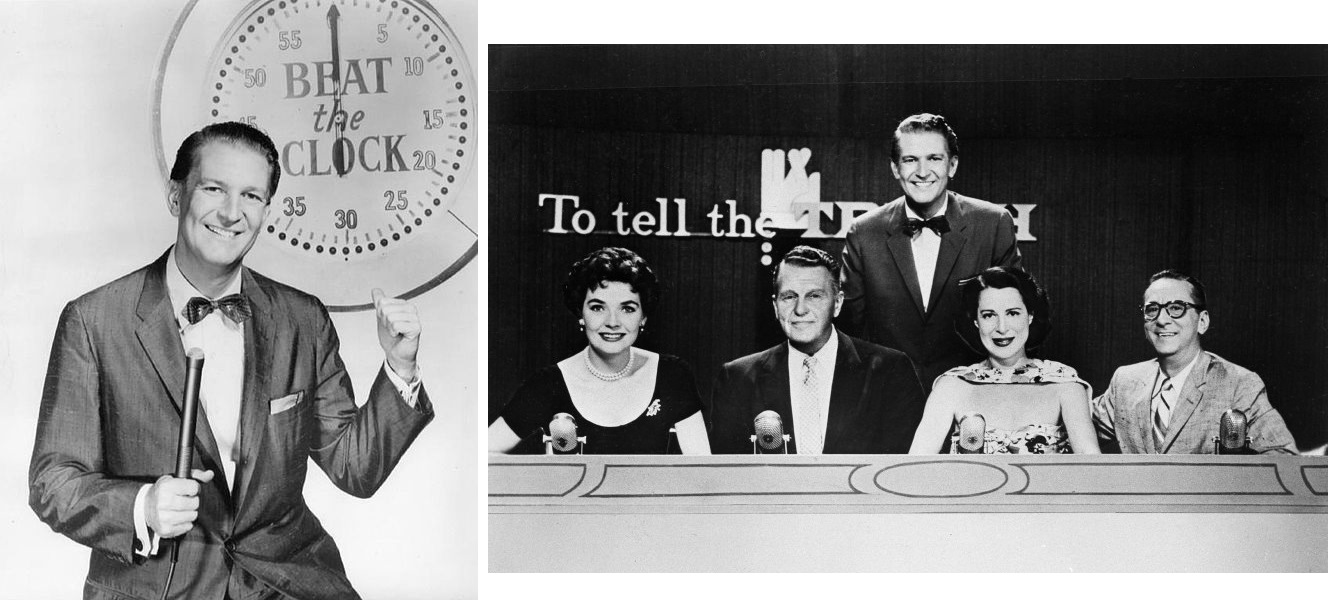
Notable among the supporting cast is Bud Collyer (misspelled as "Collier" here) as Nephew Fred. His long radio and TV career included his voicing of Superman/Clark Kent on the radio show and animated cartoons for movies and TV as well as hosting the long-running TV game shows "Beat the Clock" (1950-56) and "To Tell the Truth" (1956-68).


Bud sounds like he's using his Clark Kent voice as Fred. Fans will recall how he used to deepen that voice as Clark Kent would say, "This looks like a job for... Superman!"


The wackiest casting from our latter-day viewpoint is "Master Dickie VanPatten" as "Master Peter Cratchit." Later known as Dick Van Patten, he had a long career and was known for his roles on the early TV show "Mama" (1949-57) and the later "Eight is Enough" (1977-81). The less said about the latter, the better!

You can put him in the June Lockhart/Jill St. John/Bonnie Franklin line of later well-known performers who played an assorted Cratchit as an early credit!

The other roles are solidly performed by a professional cast of not-as-well-remembered radio actors.

Next up: how does this production stack up as a faithful adaptation?

Saturday, June 27, 2020

"A Christmas Carol" (1941) - Victor Records - Part 1


"A Christmas Carol" (1941)
Victor Records
Producer: Ernest Chappell
Scrooge: Eustace Wyatt

We stay in the audio world and jump ahead a couple of years to 1941 for Ernest Chappell's adaptation of  "A Christmas Carol" on four 12-inch 78 rpm platters  from Victor Records.

I think this is a real gem!

Give a listen to those eight sides:

Part 1: "To Begin With-"


Part 2: "The Solicitor"


Part 3: "Marley's Ghost"


Part 4: Marley's Ghost" (concluded) and "Ghost of Christmas Past"


Part 5: "Ghost of Christmas Past" (concluded)


Part 6: "Ghost of Christmas Present"


Part 7: "Ghost of Christmas Future"


Part 8: "The End of It"


Next: A look at the cast...

Monday, April 27, 2020

Victor Records: "Scrooge" - Parts 1 & 2 (1916) - William Sterling Battis - Part 2


If you got the chance to listen to William Sterling Battis with his 1916 recordings of "Marley's Ghost" and "The Ghost of Christmas Past," I'm sure you'll agree they're pretty fun.

With these 12-inch 78 rpm records, he gets some room to stretch out, so it's interesting what scenes get highlighted.

I have to wonder if Side One set a new record for most "humbugs" in less than five minutes!

These records are billed as "Character impersonation with effects," although I don't think Side 1 has nay effects, whereas Side 2 has a few, including the fiddler at Fezziwig's party. It's mostly Battis, though.

I think his monologue style is interesting, as he's sometimes he's talking to another character, but you only get his side of the conversation. It reminds me of those telephone routines that Bob Newhart used to do.

I can't really uncover a lot of information about William Sterling Battis, but he was based in America and seems to have been a Dickens specialist.

This little clipping from Dickinson College in December 1927 is very interesting:


Fascinating that they namedrop Bransby Williams!

I imagine that this sort of character impersonation would have been running out of steam in a few years once talking movies became established.

One other related piece of ephemera is also intersting. This ad for Victor Records touting them as educational tools:


Look who's on there!

I'll have to stay on the look out for the other record in the series.

Meanwhile, I think we have to wait 25 years for another recording of "A Christmas Carol" for the home market. Paging Ronald Colman!

Sunday, April 26, 2020

Victor Records: "Scrooge" - Parts 1 & 2 (1916) - William Sterling Battis - Part 1


"Scrooge - Part 1 - 'Marley's Ghost'" (1916)
b/w "Scrooge - Part 2 - 'The Ghost of Christmas Past'
Victor Records
Scrooge: William Sterling Battis

Here's one more early monologue, this time by American William Sterling Battis, another noted impersonator of Dickens characters.

He cut four 12-inch 78 rpm records in his "Scrooge" series. I've only been able to track down the first record which pairs "Marley's Ghost" with "The Ghost of Christmas Past."

They're not the same sketches as presented by Bransby Williams on his Scrooge series but they're equally fun.

Give 'em a listen:

Part 1 - "Marley's Ghost"


Part 2 - "The Ghost of Christmas Past"