Album: "Lord Buckley Blowing His Mind (and yours, too)" (Released 1966) World Pacific Records
We turn from Phil Moore and his hipster slang to a more "out there" purveyor of such: Lord Buckley.
He was an extremely odd comedian who had a part noble/part hipster persona. I'm not sure if he was ahead of his time, as that time still hasn't arrived.
Anyway, a lot of his shtick was translating classic works into jive and he turned his sights on Charles Dickens and "A Christmas Carol" with this cut from 1960:
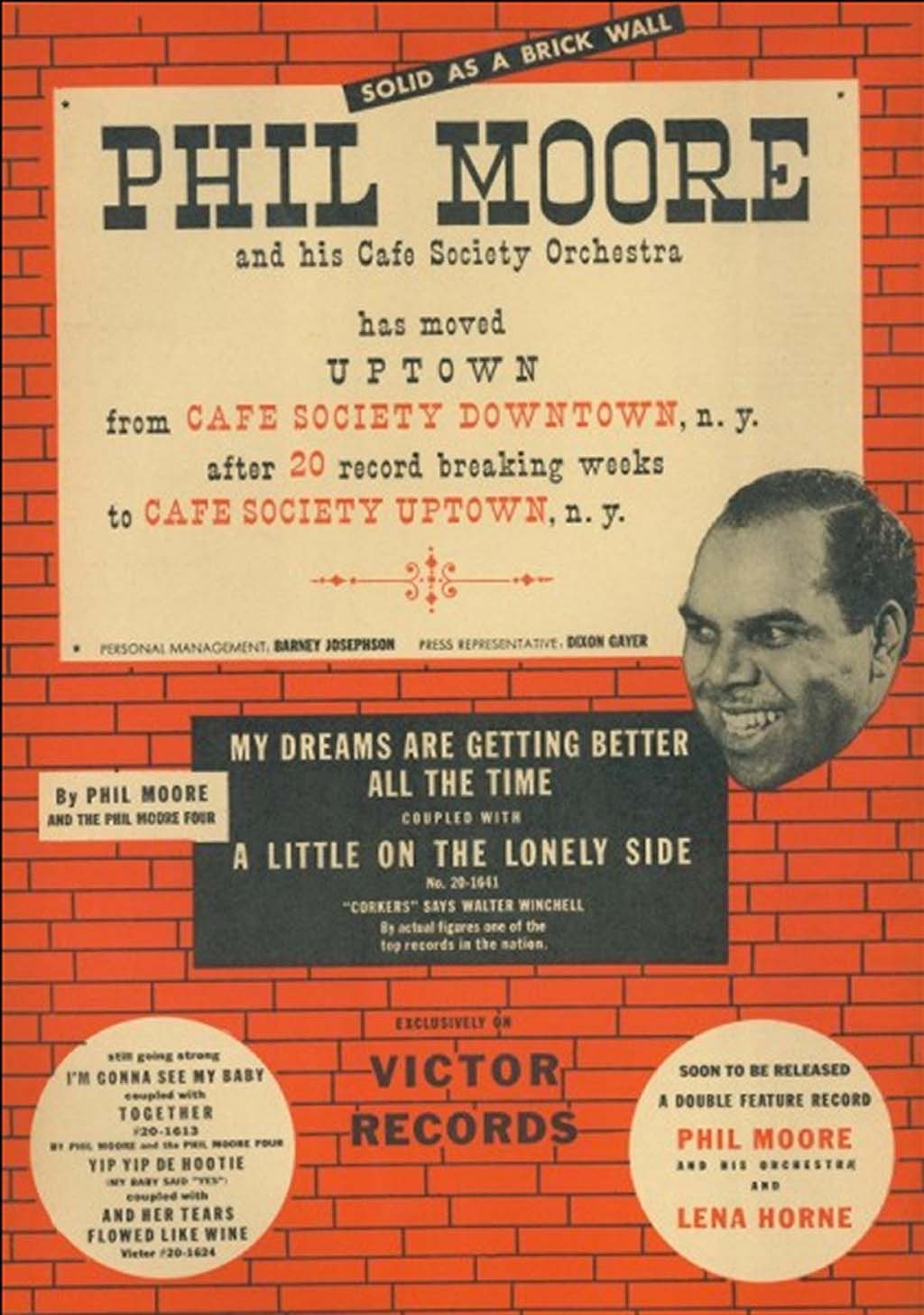
The question from last time was whether we were done with Phil Moore. The answer of course is a resounding NO!
When I think of Phil Moore, I actually think of a couple of snappy WWII era songs that he wrote.
If you were to do word association thing with me and said, "Phil Moore," my answer would be "Shoo-Shoo Baby!"
That was a song sung by the Andrews Sisters in the movie "Three Cheers for the Boys" and their single of the song on Decca Records was a huge hit in 1944:
From my penchant for reading record labels and such, I knew that someone named Phil Moore had written this sing before I knew there was a group called the Phil Moore Four. I don't know how I ever found out anything in those dark, pre-Internet days!
I also like the song "I'm Gonna See My Baby" (also 1944) which I was familiar with by way of Johnny Mercer's version on Capitol Records, the flipside of his huge hit "Candy" (sung with the great Jo Stafford and the Pied Pipers):
Thanks to the Internet, I was finally able to hear Phil Moore's version of "I'm Gonna See My Baby" with the Phil Moore Four from his earlier stint on RCA Victor Records:
Phil's version is definitely jazzier than Johnny's big band record. I get a strong King Cole Trio vibe, which is a beautiful thing!
While mining the pop culture reference points for Phil Moore's 1953 RCA Victor recording of "Chinchy Old Scrooge," I can't let it pass without pointing out the one person who gets name-dropped...
One particular line goes, "This ain't a fit night out for Clyde McCoy!"
Being somewhat hip by 1953 standards myself, I immediately recognize Clyde McCoy as the embodiment of corny music. He was a popular bandleader and trumpet player who featured the ultimate "wah-wah" sound on his horn. (This circuitously led to the non-corny wah-wah pedal for guitars in the 1960s, but that's another story!)
His type of square music is typical of what the bop cats were rebelling against. The difference between Clyde McCoy as a trumpeter and, say, Dizzy Gillespie is incalculable!
The thing is that I think Clyde McCoy is awesome! I absolutely love his theme song "Sugar Blues." He recorded it a few times, but my favorite is his 1935 version for Decca Records:
I love hipsters vs. squares circa 1953!
Just to provide a bit of context, here are "Billboard" magazine's top ten best selling singles from November 28, 1953, when "Chinchy Old Scrooge" was released:
I know all those records very well and they're not without merit, but they are pretty square!
The spiritual successor to Clyde McCoy is Pee Wee Hunt with his version of "Oh!"
Let's look at a couple of contemporary clippings that give an idea of the reaction to Phil Moore's 1953 coupling of "Chinchy Old Scrooge" and "The Blink Before Christmas" for RCA Victor Records.
The first is a review from "Billboard" of December 12, 1953:
Next is from "Jet" of December 24, 1953:
What I find most interesting is that these both imply that "Chinchy Old Scrooge" is a bop retelling of "A Christmas Carol," which it really isn't. It just uses the Scrooge name as shorthand for somebody stingy, oops! I mean chinchy!
There's no ghostly intervention or anything, although Scrooge does reform. Not that it was meant to be an adaptation and failed in achieving that goal.
The novelty song "Ebenezer Scrooge" also from 1953 (and discussed here) does actually tell the story of "A Christmas Carol" if ever so briefly.
Listening to "Ebenezer Scrooge" and "Chinchy Old Scrooge" back-to-back shows the wide span of releases from major labels in 1953!
I think the "Billboard" review is otherwise spot-on. I think it's meant as a novelty for hipsters, as it's not actually a song.
The mention of Al "Jazzbo" Collins and Steve Allen is in refence to the then-current vogue of spoken-word novelties kicked off with this recording from earlier in 1953:
The picture sleeve and other promotional material show that this was definitely marketed as a collaboration between Allen and Collins, although they started making their own records in the same vein very quickly.
I'm presuming that Phil Moore's record was an attempt by RCA Victor to jump on the bandwagon.
The piece from "Jet" is interesting as well, with the thinking that Moore's record was harmful to children. Imagine what those squares would have thought if they knew what kids listen to these days!
If you got a chance to listen to "Chinchy Old Scrooge," the 1953 recording by Phil Moore and the Phil Moore Four, I'm sure you'll agree that it's a fascinating novelty!
I do think it's meant as a novelty as the slang is so thick that you can't imagine anyone ever really sounding quite like that, even the heppest cats in 1953!
The flip side of this single, "The Blink Before Christmas" sheds a bit of light on things. Give it a listen:
The key is Don Burley, Phil Moore's co-writer on this track. Burley was a pianist like Moore, but he was also a journalist and among his accomplishments was "The Harlem Handbook of Jive" first published in 1941.
He included takeoffs of poems and stories including "The Jive Night Before Xmas," based on "A Visit from St. Nicholas" by Clement C. Moore (no relation to Phil!).
It would seem that Phil Moore used Burley's poem as the basis for the "Blink" side and took that inspiration for the "Chinchy" side.
"Chinchy Old Scrooge" (1953) Phil Moore with the Phil Moore Four Songwriter: Phil Moore RCA Victor Records
We haven't dipped our collective toe into the audio pool in a bit, so let's give a listen to this 1953 recording of Phil Moore performing "Chinchy Old Scrooge" with the Phil Moore Four:
"A Jerk of All Trades" (December 14, 1965) The Red Skelton Hour CBS Network
Moving from the odd Scrooge/Emmett Kelly mashup, we move to a more typical use of the Scrooge character, this time involving legendary comedian Red Skelton.
On the Christmas episode of "The Red Skelton Hour," as broadcast on CBS TV in 1965 was a skit featuring Red as a curmudgeonly newsstand proprietor named "E. Scrooge."
This was the "Silent Spot" segment of the show, Red being an expert pantomimist (like Emmett Kelly).
Here are some stills:
As I mentioned, this is a more common use of Scrooge in a modern setting - a mean-spirited surrogate rather than the actual Victorian-Era Ebenezer Scrooge.
In addition to Tallulah Bankhead (seen at the top with Red as the jerk), a guest star on this episode was pianist Horst Jankowski, who performed his hit "A Walk in the Black Forest."