Sunday, July 19, 2020

Bob Cratchit's Salary


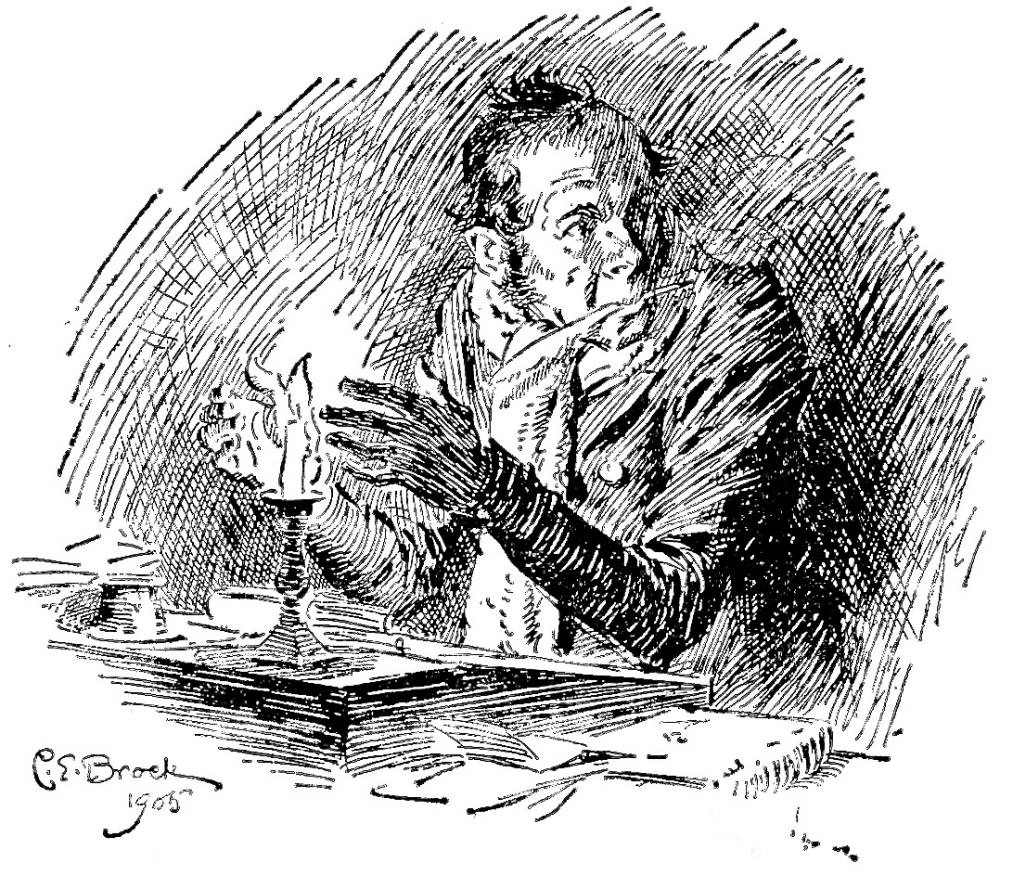
A few days ago when discussing "Dickens' Dream Children" (1901), I mentioned that the "dream-spirit" said that Tiny Tim's condition was Scrooge's fault because he underpays Bob Cratchit.

I'm still chewing on that!

It's a notion that pops up in various adaptations, but not really implied in the original "A Christmas Carol."

While it's true that if Bob made more money, he'd be able to afford medical attention for Tiny Tim, and indeed Tiny Tim does NOT die after Scrooge raised Bob's salary and became a second father to Tim, but Scrooge didn't cause Tiny Tim to have whatever condition he has.

All of which gets me to wondering if Bob is actually underpaid. He has a large family to support and it appears that they generally scrape by on his fifteen shillings a week.

Scrooge himself doesn't seem to think that's enough to support a wife and family, but no doubt Scrooge thinks a wife and family is an unprofitable proposition anyway.

But is Bob underpaid or does he get the prevailing wage for his position, said wage not being enough no matter who is paying it?

Bob has to contend with a mean boss and work in a cold little tank, but if he had a nicer boss, would he make more money, or just be warmer?

Going back to Scrooge's apprenticeship, he says that Fezziwig was wonderful to work for and we know he threw awesome Christmas parties, but did he pay Ebenezer and Dick Wilkins more than the going rate for apprentices?

I think the Fezziwig sequence illustrates to Scrooge that he should be nicer to Bob, but not necessarily give him a raise.

Is Bob particularly good at his job or just adequate? Could he actually get a better position? He's a loyal employee, but he does lack imagination.

In the book at least, Bob seems reasonably content with his job. We don't know how long he's been there, although some have adaptations have him working there when Marley was still alive, which would put his service time at seven years minimum.

Young Scrooge began to covet more money, so he gave up everything else in order to push ahead in business to make more money. Bob would presumably like more money (who wouldn't?), but he would not want to trade his happy family life for the pursuit of wealth.

Getting back to that "Dickens' Dream Children" book, it posits that Tiny Tim changed Scrooge. I think he was a large factor in Scrooge's conversion and definitely the impetus for Bob wanting to give Bob a raise, whether Bob should be making that much money or not!

And while we're at it, I get from the original book that Scrooge did not know that Bob Cratchit had a sick child, let alone that he was called Tiny Tim. I also can't imagine that Scrooge would know Martha's, Peter's or Belinda's names either.

But they all apparently exist in the "real" world, more proof that Scrooge was not dreaming. You can't dream about something real without knowing about it in advance!

Sorry for the rambling. Carry on!


Friday, July 17, 2020

The No-Name Game!


I had recently talked about Charles Dickens not really telling us the names of most of the characters in "A Christmas Carol" and ran down the names and partial names that we learned in the book.

While thinking about this later, in my attempt to avoid the Devil's Workshop, I was wondering if there were many characters that spoke in the book, but we never knew their name.

Kind of like bit parts in a movie, you know? Not exactly extras, but most likely unbilled.

So, here's my chronological list of characters who have at least one line, but we have no idea at all what their first or last name may be.

The first such charcter is one of the two portly gentleman who visit Scrooge to solicit for charity. He actually has quite a few lines, but he doesn't say his name, nor does Scrooge say it (which he may have seen on the gentleman's credentials if he actually bothered to look at them).

The portly gentleman who spoke also appears at the end of the story, while the second gentleman gets no lines and does not reappear after the beginning scene. Hopefully he remembers that there are no small parts, only small actors!

At the beginning of the book, there's also the kid who gets out the first lines of "God Rest Ye Merry, Gentleman" before being rudely interrupted. Everyone's a critic!

In the Christmas Past sequence, right after Fan comes to get Ebenezer, a "terrible voice" cries, "Bring down Master Scrooge's box, there!" This is apparently the schoolmaster, as he appears right after.

There are a ton of people at Fezziwig's Christmas Party, but Fezziwig is the only one who actually has any lines at all in the scene. Young Scrooge and Dick Wilkins never actually say anything, nor does Mrs. Fezziwig or any of the other guests.

The only other unnamed character (besides the schoolmaster) in the whole past sequence who gets quoted at all is Belle's husband, who has a few lines.

In the Christmas Present segment, all of the Cratchits say various things. We don't know all of their first names, but we know they all have the same surname.

At Fred's party, his wife has quite a few lines, but we never learn her first name and since we don't know Fred's last name, we don't know hers either.

During Fred's game of Yes and No, presumably the guests are shouting out guesses, but the only one who's directly quoted is Fred's wife's plump sister, who correctly guesses "Uncle SCro-o-o-o-oge!"

It should also be noted that the guests, including another sister, do all say "Well! Uncle Scrooge!" in unison as a toast.

The Christmas Yet to Come sequence actually has the most dialogue from unnamed characters.

The first are from the small knot of businessmen. Four of them speak: a "great fat man with a monstrous chin," another non-descript one, a third who takes some snuff and a fourth, described as red-faced with a "pendulous excrescence" on his nose!

Then there are the other two wealthy, important businessmen.

At old Joe's place, the charwoman talks a lot, but we don't catch her name. We also don't know the name of the undertaker's man, but he doesn't actually say anything.

We also have the Caroline's husband say a few lines in the future segment.

Back on Christmas Day, the window boy gets a few lines and there's also Fred's household servant.

I think that's it. Did I miss anyone?


Thursday, July 16, 2020

"Dickens' Dream Children" (1901) - Part 2


If you got to read the "Tiny Tim" segment from "Dickens' Dream Children," the 1901 volume by Mary Angela Dickens, I'm sure you found it a pleasant light read.

But, now's where we dissect what was meant to be cute little story for kids!

It's kinda sorta an excerpt from "A Christmas Carol," but it changes a few things as originally penned by Mary's grandfather, one Charles Dickens.

It starts off with an introduction of Scrooge in a very conversational manner. The omniscient narrator says Scrooge had "some wonderful and disagreeable dreams" before moving on to Tiny Tim.

Now, of course, those weren't dreams, being that "A Christmas Carol" is "a ghosts story of Christmas," but, hey, this book is aimed ta kids, so we'll let it go!

The narrator says that we're going to see how Tiny Tim spent Christmas Day. We then have an edited version of the Cratchit's Christmas dinner with the goose and pudding as seen by Scrooge with the Ghost of Christmas Present (no ghost mentioned here, though). 

Aha! That's NOT how Tiny Tim spent Christmas Day! That's how Tiny Tim would have spent Christmas Day! The Cratchit family actually had a ginormous turkey for Christmas dinner! Plot hole!

Amongst some other details, the narrator says that this was first time that Bob had taken Tiny Tim to church, which is not implied in the original book.

Because the focus is on Tiny Tim, most of Scrooge's encounters with the spirits are omitted, but we do get a "dream" sequence form the future where Tiny Tim has died.

What's interesting here is that the "dream-spirit" talks to Scrooge, saying, "Tiny Tim died because his father was too poor to give him what was necessary to make him well; you kept him poor." Harsh words from a spirit who doesn't usually talk!

The idea that Tiny Tim could possibly get better if Scrooge gave Bob a raise is only implied in the original book, but it's often stated outright as it is here in various adaptations, including Howdy Doody's version. Does that need to be spelled out for kids?

But, Scrooge does indeed give Bob a raise and Tiny Tim did not die - "not a bit of it."

The text here says that Tiny Tim was the main catalyst for Scrooge's reformation. Fair enough.

So, this is an interesting little story, aimed squarely at kids, probably younger ones not ready for the whole "A Christmas Carol" yet.

No doubt good entertainment for early twentieth century kids!

Wednesday, July 15, 2020

"Dickens' Dream Children" (1901) - Part 1


"Dickens' Dream Children" (1900)
Adaptor: Mary Angela Dickens
Illustrator: Harold Copping

Here's Raphael Tuck and Sons getting some more use out of Harold Copping's illustrations with this 1900 volume called "Dickens' Dream Children."

It features excerpts from several Dickens novels dealing with children, ostensibly edited/adapted by his granddaughter, Mary Angela Dickens.

For our purposes, we take a look at the section for Tiny Tim...


Next, some intriguing things about this!

Tuesday, July 14, 2020

Triple Tuck!

While we're still perusing postcards issued by Raphael Tuck and Sons, we come across these three that use the same illustration. It's Harold Copping's version of the Cratchit's Christmas dinner, with Mrs. C. presenting the pudding.

I'm not sure what the dates of issue were, but they seem to be from the 1910s?

Here they are:

The whole family's in this one!

Poor Martha got cropped out!

Bob and Tiny Tim join Martha!


Enterprising work by the Tucks!

Monday, July 13, 2020

"Gem Glosso" Christmas Series No. C-5068 (1914)


"Gem Glosso" Christmas Series No. C-5068 (1914)
Raphael Tuck & Sons

Here's another postcard from Raphael Tuck & Sons, this one from 1914.

What's interesting is that there ae a couple of variations of this card, despite  them having the same number of C-5068.

They both feature an illustration of a newly jovial Scrooge on the right-hand side, but they have different seasonal Dickens quotes on the left.

I'm partial to the top one, as "Happy Christmas" sounds so British!

Whatever the case, they're very evocative!

And "Gem Glosso" is such a cool name!


Sunday, July 12, 2020

"Dickens" Post Card No. 1639 (1904)


"Dickens" Post Card No. 1639 (1904)
Scrooge (A Christmas Carol)
Raphael Tuck & Sons

We continue to kick it old school with this intriguing postcard published by Raphael Tuck and Sons in 1904.

This firm issued a ton of postcards, which were all the rage in England in the late 1800s and early 1900s.

As with any British purveyor of illsuartions, Dickens characters made their way into the proceedings, hence this character study of one Ebenezer Scrooge.

The side indicates that this was "Phototyped in Saxony."  I don't really know what that menas, but this appears to be an actual photo of a pretty Scroogey guy!

I like it!